


Your Goldendoodle looked perfectly brushed out on Tuesday. By Friday, there’s a quarter-sized mat hiding behind her ear, and you have no idea how it got there. Sound familiar? That’s not bad parenting. It’s just how goodle grooming tools become non-negotiable once a Doodle’s coat passes the puppy stage, because long, flowing coats hide tangles in places you’d never think to check.
The honest answer: you need the right goldendoodle grooming tools, used in the right order, more often than you probably expect. Skip either piece and the mats win. This guide walks through the exact toolkit, the brushing method groomers actually use, and a schedule you can realistically keep up with at home.
“Why Does My Goldendoodle Matt So Fast?”
Here’s the frustrating part. A Doodle’s coat isn’t one texture. It’s a blend of the Poodle’s tight curl and the Retriever’s straighter, softer undercoat, tangled together (literally) in every single strand.
That combination creates friction. Curly hair wants to wrap around itself, and when it’s mixed with straight undercoat fuzz, the two textures grab onto each other like Velcro. According to grooming guidance from the American Kennel Club, mixed and curly coat types are significantly more prone to matting than single-coated breeds, since loose undercoat hair gets trapped instead of shedding out naturally.
Translation: your Doodle isn’t shedding “wrong.” She’s just built in a way that traps dead hair close to the skin. Left alone for even a few days, that trapped hair felts together into a mat, usually in friction zones like behind the ears, in the armpits, and around the collar line.
Mats don’t start on the surface. They start at the skin and work their way out, which is exactly why a brush that only skims the topcoat will miss them every time.
This is the root reason goldendoodle grooming tools matter so much more here than they would for, say, a short-haired Lab. You’re not just making the coat look nice. You’re preventing a painful, skin-tight mat that eventually requires a full shave-down to fix.
The Core Toolkit: What You Actually Need
Walk into any pet store and you’ll find forty brushes claiming to be “perfect for Doodles.” Most aren’t. Here’s what actually earns a spot in a long-coat Goldendoodle’s grooming kit.

- A quality slicker brush. This is your daily driver, the tool that pulls loose undercoat out before it felts into a mat.
- An undercoat rake. Reserved for weekly deep passes, especially during shedding season when the undercoat piles up fast.
- A steel comb with both wide and fine teeth. Think of this as your mat detector. If the comb glides through, you’re clear. If it snags, you’ve found trouble before it got out of hand.
- A detangling or leave-in conditioning spray. Dry brushing on a long coat creates static and breakage. A light mist of spray gives the brush something to glide on instead of yanking.
- A gentle, coat-conditioning shampoo for bath day. Clean hair detangles easier than dirty hair, full stop.
- A grooming table or non-slip mat. Not glamorous, but it keeps your dog (and your back) from fighting you during a 20-minute session.
If your Doodle is also due for a trim between professional visits, it’s worth reading up on best dog clippers for Goldendoodle teddy bear cuts before you attempt any at-home shaping. Clipping and brushing are two very different skill sets, and rushing into clippers without the brushing routine down first usually ends in an uneven, choppy cut.
Line Brushing 101: The Step-by-Step Method Groomers Use
Most owners brush the way you’d brush your own hair: top down, quick strokes, done in two minutes. For a Doodle’s double texture coat, that approach is basically useless. It smooths the surface while leaving the undercoat completely untouched.
Line brushing fixes that. Groomers use it because it forces you to actually reach skin level, layer by layer, instead of guessing.
- Start with a dry coat (or lightly misted with detangling spray) and section the hair with your free hand, like you’re parting it.
- Hold the top layer of hair up and out of the way. You’re exposing a thin “line” of coat down near the skin.
- Brush that bottom line in short, flicking strokes using a Chris Christensen Groomer’s Bundle Karben I Slicker, working from skin outward, not the other way around.
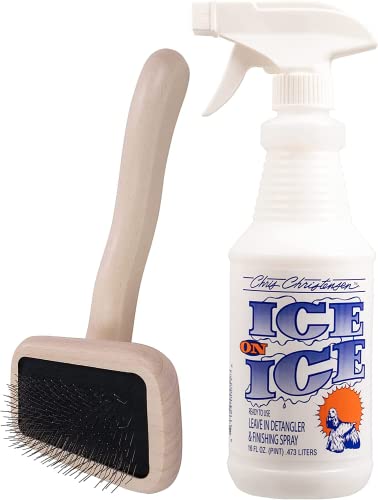
- KARBEN SLICKER BRUSH – The Kärben Slicker brush by Chris Christensen is expertly crafted to cater to the needs of Groome…
- IDEAL FOR ALL COAT TYPES – Kärben Slicker Brushes are perfect for removing tangles, matts, shedding coat, and debris, wh…
- ICE ON ICE – Chris Christensen’s Ice on Ice is a ready to use leave-in conditioner and detangling spray. While it also d…
We tested this slicker on a six-month coat transition (the stage where mats are most brutal) and the pin flex genuinely surprised us. It’s firm enough to break up loose undercoat without feeling like you’re scraping skin. The handle has a rubberized grip that doesn’t slide around even when your hands are a little damp from a spray bottle. Our one gripe: the pins sit close together, so if you’re hitting an already-formed mat instead of using it preventatively, it can snag and pull. Use it for maintenance, not rescue work.
- Release that layer, grab a new thin section just above it, and repeat the process up the body.
- Once you’ve line-brushed, run a steel comb through the same section. This is your proof of work, if the comb catches, go back over that spot.
Full sessions take anywhere from 15 to 25 minutes depending on coat length. It feels slow the first few times. It gets faster once your hands learn where the problem zones live (ears, armpits, tail base, behind the collar).
Slicker Brush vs. Pin Brush vs. Comb: Which Wins for Long Coats?
Owners often buy one brush and expect it to do everything. On a long Doodle coat, that’s setting yourself up to fail. Each tool solves a different problem, and knowing which one to grab matters more than which brand you buy.
| Tool | Best For | Pros | Cons | Price Tier |
|---|---|---|---|---|
| Slicker Brush | Daily/every-other-day maintenance, loose undercoat removal | Fast coverage, good at preventing fresh mats, works on damp or dry coat | Can irritate skin if pressed too hard, not ideal on existing mats | $$$ |
| Pin Brush | Finishing touches, smoothing after slicker work | Gentle, good for sensitive-skinned Doodles, low static | Doesn’t reach undercoat alone, needs pairing with another tool | $$ |
| Steel Comb | Mat detection, finishing combouts, face and leg detail work | Precise, catches hidden tangles a brush misses, dual-tooth design handles multiple coat zones | Slower for full-body use, not meant to replace a brush | $ |
Our take after running all three through a full grooming season: the slicker does the heavy lifting, the comb catches what you missed, and the pin brush is really more of a polish step for show coats than a daily essential. If you only buy one tool to start, make it the slicker. If you want to actually confirm your work, add the comb next.

For comb testing, we liked the Metal Comb for Dogs Grooming Detangler specifically for face and paw detail, areas where a bulky slicker brush just doesn’t fit.

- EASY DEMATTING & DETANGLING: Our dog grooming comb features extra-long stainless-steel teeth that glide through tough kn…
- EXTRA LONG PINS: Engineered with PINs that are 30% longer, this dematting comb reaches deeper into dense, curly, or long…
- ERGONOMIC HANDLE: Designed with a non-slip, ergonomic handle, this metal dog comb ensures a secure grip and reduces hand…
The wide teeth glide through fluffy leg feathering without catching, and the fine teeth on the other end are genuinely useful for checking behind the ears, the number one mat hotspot on nearly every long-coated Doodle we’ve handled. It’s lightweight, which is nice after a few minutes of detail work, though the handle is on the slim side. If you’ve got larger hands, it can feel a little flimsy during longer sessions.
How Often Is Too Often? Building a Sustainable At-Home Schedule
Here’s where a lot of well-meaning owners get it wrong. They brush hard once a week and figure that covers it. For a short, single coat, maybe. For a long Doodle coat, once a week is nowhere near enough.
Professional groomers, including guidance referenced by the International Professional Groomers Association, generally recommend brushing long Doodle coats every one to two days. Not because Doodles are fragile. Because that’s roughly how fast loose undercoat accumulates enough to start felting.
A realistic weekly rhythm looks something like this:
- Quick slicker pass every other day, five to ten minutes, focused on friction zones
- One full line-brushing session per week, covering the entire body
- Bath day every two to three weeks using a conditioning formula, like a Dog Shampoo Half Gallon that Cleans Conditions and Detangles, followed immediately by a thorough brush-out while the coat is still damp

- LARGE VALUE SIZE (64 OZ): Save time and money with our extra-large half gallon 64oz bottle of premium dog shampoo, suita…
- 4-IN-1 DOG SHAMPOO: Effectively cleans, conditions, detangles, and moisturizes your dog’s skin. Keep your dog’s fur soft…
- PROUDLY MADE IN THE USA: Our shampoo for dogs is a quality American-made product formulated and tested in the best facil…
We ran this half-gallon formula through two bath cycles on a notoriously tangle-prone apricot coat. The slip it leaves behind is the real selling point, you can actually feel the comb moving easier through wet hair instead of catching every few strokes. It smells mild rather than perfume-heavy, which matters if your dog already shakes off half the bath water onto your shirt. The only annoyance: the half-gallon jug is heavy and a little awkward to pour one-handed, so keep a smaller squeeze bottle nearby for actual bath time.
Stick to that rhythm and most Doodles stay mat-free between professional visits. Skip more than three or four days and you’re rolling the dice, especially around the ears and collar. If the cost of professional upkeep is a concern alongside your at-home routine, it’s worth comparing options in our breakdown of Mini Goldendoodle grooming costs for groomer versus DIY haircuts, which covers where DIY actually saves money and where it doesn’t.
Key Takeaways
- Doodle coats mat faster because curly and straight textures trap loose undercoat against the skin
- The core toolkit is a slicker brush, steel comb, undercoat rake, detangling spray, and conditioning shampoo
- Line brushing (not surface brushing) is the only method that reliably reaches skin level
- Each tool, slicker, pin brush, comb, solves a different problem rather than being interchangeable
- Brushing every one to two days prevents the kind of deep mats that force an unwanted shave-down
Building the right set of goldendoodle grooming tools isn’t about buying everything on a Doodle grooming checklist. It’s about using a slicker brush for daily upkeep, a comb for verification, and a realistic schedule you’ll actually stick with. Get those three things right and the quarter-sized surprise mat behind the ear becomes a rare event instead of a weekly headache.
Frequently Asked Questions
My dog hates being brushed. How do I make line brushing less stressful?
Break the session into two or three short bursts instead of one long sitting. Brush for five minutes, give a treat and a break, then come back later for the next section. Pairing the slicker brush with a calm, low-key environment (not right after playtime, when your dog is already wound up) usually gets a much better reaction than pushing through one marathon session.
I found a mat already stuck to the skin. Should I try to brush it out myself?
If a mat is tight against the skin and won’t loosen with gentle finger separation and detangling spray, stop brushing it. Pulling at a skin-level mat risks bruising or tearing fragile skin underneath. A dematting comb can help with looser mats, but skin-tight ones are safer left to a professional groomer with proper clippers.
Is a slicker brush safe to use every single day, or is that too much?
Daily use is fine as long as you’re using light, flicking wrist strokes rather than pressing hard into the skin. Problems come from heavy-handed pressure or using the same brush on an area that’s already irritated. If you notice redness or flaking in one spot, switch to a comb there and let the skin recover for a day or two.
Why does my Goldendoodle’s coat tangle more in certain seasons?
Shedding cycles in spring and fall push extra undercoat loose at once, and that loose hair gets trapped in the topcoat instead of falling away like it would on a single-coated dog. During those stretches, add an extra undercoat rake session each week on top of your normal slicker routine to clear the buildup before it felts.


