


A dog training collar can turn a frustrating few weeks of ignored commands into a calm, cooperative Goldendoodle who actually listens, but only if you pick the right type and use it the right way. Goldendoodle puppies aren’t stubborn in the way people often assume. They’re smart, and that intelligence makes them selective about which cues are worth their attention. The right tool, paired with patience and consistency, closes that gap faster than nagging ever will.
If you’ve got a Goldendoodle puppy who seems to “know” the sit command perfectly in your kitchen but completely forgets it exists the moment there’s a squirrel in the yard, you’re not imagining things. This is a real behavioral pattern, and it’s one of the most common reasons pet parents start searching for a dog training collar in the first place. Let’s talk about why it happens, what kinds of tools actually help, and which five products are worth your money.
Why Goldendoodle Puppies Act Stubborn (It’s Not What You Think)
Goldendoodles are a cross between Golden Retrievers and Poodles, two breeds that both rank near the top of canine intelligence charts. According to the American Kennel Club, Poodle-mix temperaments often show high problem-solving ability combined with independent decision-making. That combination can look like defiance to a frustrated owner, but it’s really a puppy weighing options and deciding which behavior earns the better payoff.
True defiance, where a dog understands a command and refuses out of spite, isn’t really a thing in canine behavior science. What looks like stubbornness in a Goldendoodle puppy is usually one of three things: the dog hasn’t fully generalized the command across different environments, the distraction in front of them is more rewarding than your praise, or the training sessions have gotten boring and repetitive. A good dog training collar, used correctly, helps bridge that gap between “knows it at home” and “does it everywhere.”
Types of Training Tools That Respect Sensitive Doodle Coats and Skin
Doodle coats are different from a short-haired dog’s coat, and that matters when you’re shopping for neck-worn equipment. Curly or wavy fur can mat under tight-fitting collars, and some Doodles have more reactive skin than their Retriever or Poodle parents. Here’s a quick breakdown of the main categories you’ll run into.

Vibration collars use a gentle buzz instead of a shock to interrupt unwanted behavior or get a puppy’s attention before a verbal cue. These tend to be the gentlest option and work well for sound-sensitive Doodles. Remote training collars (often grouped under the e-collar umbrella) give you a range of stimulation levels, from vibration-only up to low-level static, controlled from a handheld remote. The best ones let you dial in a level so low the dog barely notices it, used more as a tap on the shoulder than a correction. Head halters, like a Gentle Leader style tool, don’t use any electronic stimulation at all. They redirect the head and reduce pulling through gentle pressure, which makes them a solid pick for leash training a strong, excitable Goldendoodle puppy.
For coat health, look for collars with wide, flat contact points rather than thin prongs, and remove any training collar for several hours a day to prevent fur breakage or skin irritation underneath the contact points.
Top 5 Picks for Stubborn Goldendoodle Puppies
We looked at adjustability, humane stimulation range, waterproofing, and battery life to narrow this list down. A puppy training tool that dies mid-walk or can’t survive a muddy backyard session isn’t worth the investment, no matter how many features it has on paper.
One option that comes up often for multi-dog households or families who want backup units is the Shock Collar for Dogs 3 Pack – 4500FT Dog Training Collar. The long remote range is useful once your Goldendoodle graduates to off-leash recall practice in a larger yard or open field, and having three units means you’re covered if one battery dies before a training session.

- ADJUSTABLE STIMULATION LEVELS: Features multiple stimulation levels, allowing you to customize 4 Effective Training Mode…
- 4500FT Long Range:Perfect for multi-dog households who want to grant their furry companions ultimate outdoor freedom to …
- 3-Channel Multi-Dog Control:The smart remote supports an advanced 3-channel system, allowing you to seamlessly train up …
For pet parents who want finer control over stimulation strength, the E-Collar Educator FOB 300 Yard Dog Training Collar w/Finger Control stands out because of its dial-based intensity adjustment. That matters a lot for Goldendoodles, since this breed mix tends to be more sound and touch sensitive than some working breeds, so a trainer who can nudge intensity up or down in small increments gets better results with less fuss.
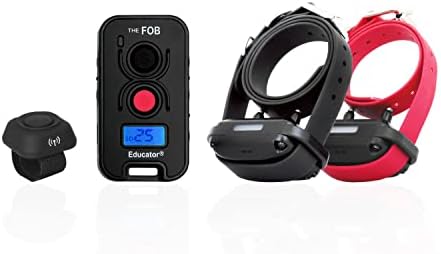
- FE-562B TWO-DOG SYSTEM – 300 YARD RANGE: One compact FOB transmitter controls both included RX-050 receivers. Follow the…
- BLUETOOTH FINGER BUTTON – PAIR BEFORE USE: Included Finger Button connects to the FOB transmitter via Bluetooth for clos…
- PROGRAMMABLE CONTROLS: Programmable S buttons can be configured for Electronic Stimulation with a Pulsing or Tapping Sen…
If your Goldendoodle is still a smaller puppy or you’ve got a Mini or Medium Goldendoodle, weight and bulk around the neck matters more than people expect. The Shock Collar for Small Dogs, Ultra-Light & Slim Dog Training Collar was built with smaller frames in mind, and the slimmer housing sits better under a fluffy Doodle coat without weighing down the neck or tangling fur.

- 【40% Smaller/Lighter/Slimmer Design】The latest 2026 model, featuring an 40% smaller/lighter/slimmer dog training collar,…
- 【Tailored for Small Dogs】Suitable for small dogs with neck sizes from 6-19 inches, equipped with a breathable and adjust…
- 【Innovative Training Modes】Offers a total of 198 adjustable levels for precise training, including sound, vibration, and…
Rounding out a shortlist of five, a vibration-only collar and a padded head halter fill the gap for owners who want to start with the gentlest possible dog training collar before ever introducing static stimulation. Many trainers recommend starting here and only moving up the ladder if a puppy genuinely needs more.
Comparison Table: 5 Best Dog Training Collars for Stubborn Goldendoodle Puppies
| Product | Collar Type | Best For | Waterproof | Battery Life | Price Tier |
|---|---|---|---|---|---|
| Shock Collar 3 Pack (4500FT Range) | Remote training collar | Multi-dog households, long-range recall | Yes | Long-lasting rechargeable | $$ |
| E-Collar Educator FOB (300 Yard) | Remote training collar | Precise, adjustable stimulation levels | Yes | Long-lasting rechargeable | $$$$ |
| Shock Collar for Small Dogs (Slim Fit) | Remote training collar | Mini/Medium Goldendoodles, smaller necks | Yes | Moderate rechargeable | $$ |
| Vibration-Only Collar (generic category pick) | Vibration dog collar | Sound-sensitive puppies, gentlest start | Varies by model | Moderate rechargeable | $ |
| Padded Head Halter | Head halter (no electronics) | Leash pulling, zero-stimulation preference | N/A | N/A | $ |
If your Goldendoodle puppy’s biggest issue isn’t recall but mouthing, nipping, or chewing furniture out of frustration, a dog training collar built for correcting aggressive puppy behavior can be paired with other tools, including an anti-chew spray designed to stop biting fast, for a more complete behavior plan.

What the Research Actually Says About Punishment vs. Reward
A 2020 study published in PLOS ONE (Vieira de Castro et al.) compared dogs trained with reward-based methods against dogs trained with aversive methods, including shock and prong-style corrections. The reward-trained dogs showed fewer problem behaviors and lower stress indicators overall. That doesn’t mean every remote training collar is off the table, but it does mean the stimulation level matters enormously, and so does how the tool gets introduced.
Any dog training collar is only as humane as the hand holding the remote. The goal is always communication, not correction for its own sake, and the lowest effective setting should always be your starting point.
The American Veterinary Society of Animal Behavior has also weighed in here, stating in its official position paper that punishment-based training tools carry a higher risk of triggering fear responses and, in some cases, aggression, especially when timing or intensity is off. That’s a big part of why this guide leans toward vibration dog collar options and low-intensity remote settings as the starting point for a stubborn Goldendoodle puppy, rather than jumping straight to higher stimulation levels.
How to Introduce a Dog Training Collar Without Creating Fear
The order you do things in matters just as much as which dog training collar you buy. Rushing this process is the number one reason a puppy ends up fearful of the collar itself rather than responsive to it.
- Step 1: Let your puppy wear the collar, powered off, around the house for a few days so it becomes a normal object rather than a signal that something unpleasant is coming.
- Step 2: Once the collar is a non-event, turn it on at the lowest vibration or stimulation setting during a calm, low-distraction moment, like in the backyard with no other dogs around.
- Step 3: Pair the very first activation with a treat and praise immediately after, so the puppy builds a positive association rather than a startled one.
- Step 4: Gradually increase distraction level over several sessions. Only raise stimulation intensity if the lowest setting genuinely isn’t getting a response, and never raise it out of frustration.
- Step 5: Keep every session short, five to ten minutes is plenty for a puppy, and always end on a success so the collar stays associated with good outcomes.
If at any point your Goldendoodle puppy shows signs of stress, like tucking the tail, avoiding the collar, or refusing to engage, that’s a signal to pause and go back a step. A good dog training collar should never need to be forced onto a scared puppy. For puppies with more serious reactivity or bite history that goes beyond typical stubbornness, it’s worth exploring professional dog bite rehabilitation support from a qualified behaviorist rather than relying on equipment alone.
Final Thoughts on Picking the Right Tool
A stubborn Goldendoodle puppy isn’t a lost cause, and in most cases, the “stubbornness” fades once training becomes more consistent across different environments. The right dog training collar speeds that process along, but it works best as one piece of a bigger approach that includes praise, consistency, and patience. Whether you land on a vibration dog collar, a full remote training collar system, or a simple head halter, the goal stays the same: better communication, not more pressure.
Frequently Asked Questions
Is a dog training collar safe for a Goldendoodle puppy’s sensitive skin?
Yes, when fitted correctly and not left on for extended periods. Choose a model with flat, wide contact points rather than thin prongs, check the fit weekly as your puppy grows, and remove the collar for several hours each day to let the skin and coat breathe underneath the contact area.
At what age can I start using a vibration dog collar on my Goldendoodle puppy?
Most trainers recommend waiting until a puppy is at least four to six months old and has already learned basic cues like sit and come through reward-based methods first. Introducing any training tool too early, before basic obedience foundations exist, tends to confuse puppies rather than help them.
What’s the difference between a vibration collar and a remote training collar?
A vibration collar only produces a buzzing sensation used to get attention or interrupt a behavior, with no static stimulation option at all. A remote training collar typically offers a wider range, from vibration-only up through adjustable low-level static settings, giving owners more flexibility as training needs change.
Can a puppy training tool alone fix stubborn behavior, or do I need more?
A puppy training tool works best as part of a full training routine, not as a standalone fix. Consistency, positive reinforcement, short daily sessions, and realistic expectations matter just as much as the equipment itself, and most stubborn behavior improves faster when all of these are combined.


