


If you’ve ever wrestled a pair of household scissors through a Goldendoodle’s matted armpit fur at 9pm because the groomer appointment is three weeks out, you already know the panic. Doodle dog clippers built specifically for dense, curly coats are the fix, and the short answer is this: you want a detachable-blade, low-noise clipper with steady torque rather than a cheap trimmer marketed for short-haired breeds. Those bargain-bin clippers stall out in thick fur, overheat, and yank instead of cutting, which is exactly how clipper burn happens.
This guide walks through why Doodle coats are genuinely different from a Lab’s or a Beagle’s, then reviews five clippers worth considering for home grooming between salon visits. You’ll also get a data-backed buying checklist and a safety routine to protect your dog’s skin while you work. No fluff, just what actually matters when you’re standing over a squirmy 60-pound Bernedoodle with a shedding blade in hand.
Why Doodle Coats Need Specialized Clippers
Poodle-crossbreed coats aren’t like typical shorthaired fur. They’re low-shedding, which sounds great until you realize it means the loose undercoat has nowhere to go. Instead of falling out and landing on your floor, it tangles into the topcoat and forms mats close to the skin, especially behind the ears, under the collar, and in the armpits.
The American Kennel Club notes that Poodle-mix coats generally need professional grooming every four to six weeks to stay ahead of matting, and that gap is exactly why so many pet parents attempt clipper touch-ups at home. A standard clipper designed for a Beagle’s flat coat just doesn’t have the torque or blade spacing to move through dense, curly, high-density fur without bogging down.
That density is also why generic clippers heat up fast on Doodles. The blade has to work through far more hair per square inch than it would on a smooth-coated dog, and friction plus a struggling motor is a recipe for a hot blade against sensitive skin. This is the core reason doodle dog clippers exist as their own product category rather than a marketing gimmick.
Doodle coats behave less like fur and more like wool. They insulate, they mat, and they punish any tool that isn’t built for sustained, high-density cutting.
The 5 Best Low-Shedding Clippers Reviewed
Here’s the lineup we’d actually put in a Doodle owner’s grooming kit, ranked by how well each handles curly, dense fur without dragging or overheating.
1. Hansprou Dog Clippers for Grooming (12V Professional)
This is a solid entry point for owners who mainly need to handle sanitary trims, paw pads, and light touch-ups between full grooms. The Hansprou Dog Clippers for Grooming run on a 12V motor with adjustable speed settings, which helps when you’re moving from a curly Poodle-mix topcoat to the thinner hair around the ears and face.

- 12V High -Speed Strong Power Motor: Hansprou professional dog grooming clippers have strong power, no hair sticking, plu…
- High Quality Titanium Alloy Blade + Ceramic Moving Blade: provide excellent cutting performance.Detachable blades are ea…
- Low Vibration + Ultra Quiet Design:The noise when dog trimming working is only about 50 db, Hansprou dog clippers to hel…
Pros: budget-friendly price tier, quiet enough for noise-sensitive dogs, cordless convenience for touch-ups.
Cons: not built for full-body clips on thick double-textured coats, blade dulls faster under heavy daily use.
2. Laube Dirty Dog Cordless 2-Speed Pet Grooming Clippers
This one is closer to what a mobile groomer might carry. The Laube Dirty Dog Cordless 2-Speed Pet Grooming Clippers deliver noticeably more torque than entry-level trimmers, which matters when you’re pushing through a matted Bernedoodle undercoat instead of just tidying up a clean coat.

- COMFORTABLE CONTROL: The Dirty Dog by Laube clippers are ergonomically designed for grooming professionals, veterinarian…
- UNMATCHED CLIPPER PERFORMANCE: Experience the Laube difference with the Dirty Dog’s all-new power, torque, and speed at …
- CORDLESS CONVENIENCE: Embrace the freedom of cordless grooming! Its lithium-ion battery TWIST N LOCK powerpack provides …
Pros: two-speed motor for switching between body and detail work, cordless freedom, durable build meant for repeated grooming sessions.
Cons: premium investment compared to basic home clippers, heavier in hand for longer sessions.

3. Detachable-Blade Ceramic Clipper Sets (General Category Pick)
Look for sets that let you swap blade sizes (a 7F, 4F, and 10 combo covers most Doodle grooming needs) without buying a new clipper each time. Ceramic blades run cooler than steel over long sessions, which is a meaningful advantage on a Poodle-crossbreed coat because you’re often clipping continuously for 20 to 30 minutes per dog.
Pros: interchangeable blades extend the tool’s life, ceramic stays cooler against skin, better for longer grooming sessions.
Cons: higher upfront cost, replacement blades add to long-term spending.
4. High-RPM Steel Blade Clippers (General Category Pick)
For dogs with thick, wiry, or double-textured coats (common in first-generation Doodles), a clipper with a higher RPM steel blade cuts through density better than lower-powered models. These tend to run louder, so they’re a better fit for dogs that aren’t noise-sensitive.
Pros: handles dense mats and thick undercoat efficiently, widely available replacement blades.
Cons: louder motor can stress anxious dogs, steel blades heat up faster than ceramic.
5. Quiet Cordless Trimmers for Face and Paw Detail
Not every clipper needs to be a workhorse. A quiet, low-vibration trimmer dedicated to facial trims, paw pads, and sanitary areas protects your main clipper’s blade from unnecessary wear and keeps sensitive zones stress-free.
Pros: gentle on sensitive areas, low noise reduces anxiety, lightweight for precision work.
Cons: underpowered for full-body use, best as a companion tool rather than a primary clipper.
Doodle Dog Clippers Comparison Table
| Clipper | Blade Type | Motor Speed | Noise Level | Best For | Price Tier |
|---|---|---|---|---|---|
| Hansprou 12V Professional | Steel, fixed | Adjustable, moderate RPM | Low to moderate | Touch-ups, sanitary trims | $$ |
| Laube Dirty Dog Cordless | Steel, detachable | 2-speed, high RPM | Moderate | Full-body clips, thick coats | $$$$ |
| Ceramic Detachable-Blade Set | Ceramic, detachable | High RPM | Moderate | Long sessions, heat-sensitive skin | $$$$$ |
| High-RPM Steel Set | Steel, detachable | Very high RPM | High | Double-textured, matted coats | $$$ |
| Quiet Cordless Face Trimmer | Steel, fixed | Low RPM | Very low | Face, paws, anxious dogs | $ |
Data-Backed Buying Criteria for Doodle Coat Clippers
According to a 2023 National Dog Groomers Association of America survey, 68% of professional groomers recommend detachable-blade clippers specifically for double-textured Doodle coats, citing reduced clipper burn compared to fixed-blade models. That’s a meaningful number when you consider clipper burn is one of the most common at-home grooming injuries reported for curly-coated breeds.

Detachable blades matter for two reasons. First, you can swap to a shorter guard when hair gets matted and a longer one for maintenance clips, without buying separate tools. Second, cooler-running blades reduce the friction that leads to irritated, red skin along the belly and legs.
When shopping for dog grooming clippers, prioritize these specs:
- Blade material: ceramic runs cooler over long sessions; steel is more affordable but heats up faster.
- Motor RPM: higher RPM cuts through dense fur with less dragging, which reduces pulling on tangled areas.
- Noise output: quieter motors matter more than most owners expect, especially for anxious or noise-sensitive Doodles.
- Blade compatibility: detachable systems let you size up or down without replacing the whole unit.
- Grip and weight: a lighter clipper reduces hand fatigue during 20-minute-plus sessions on a big Standard Poodle mix.
If mats are already established before you even reach for clippers, the right brush matters just as much as the right blade. A quality slicker brush for Doodles used two to three times a week can prevent most of the tangles that force emergency clipper sessions in the first place.
Step-by-Step At-Home Grooming Safety Checklist
Clipper burn, nicked skin, and stressed-out dogs are almost always preventable. Here’s the routine we’d recommend before you turn on any clipper on a Doodle coat.
- Brush out mats first. Never run a clipper directly over a mat. Work it loose with a slicker brush or dematting comb before clipping.
- Test the blade temperature. Touch the blade to your wrist every few minutes. If it feels hot, pause and let it cool or switch blades.
- Clip in the direction of hair growth. Going against the grain increases friction and irritation risk on curly coats.
- Keep skin taut. Gently stretch loose skin around joints and the belly so the blade glides evenly instead of catching folds.
- Take breaks every 10 minutes. This protects both the motor and your dog’s patience.
- Use a grooming hammock for wiggly dogs. A tool like the PAWCHIE Dog Grooming Hammock Harness can keep a squirmy Doodle secure and calm, which reduces the chance of an accidental nick during a sudden movement.
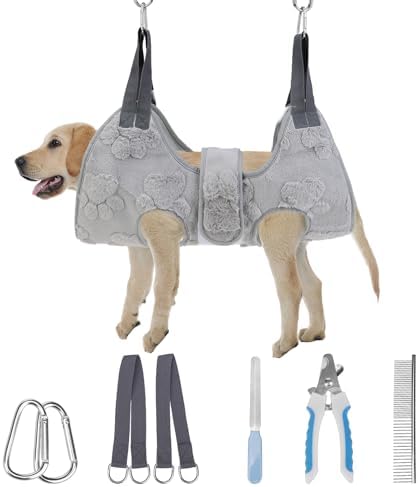
- PROFESSIONAL DOG GROOMING KIT: Dog nail trimming sling hammock is equipped with solid, thicker and super strong carabine…
- POWERFUL FUNCTIONS: This dog nail clipping hammock can be used on both sides. One side is made of crystal velvet and the…
- SAFE DOG HAMMOCK FOR NAIL TRIM: Just place pet legs in holes, then connect the D-ring strap to the dog grooming hammock …
If your dog is generally anxious about grooming tools turning on near their face or paws, it’s worth addressing that stress separately rather than just pushing through the session. Our guide on calming aids for hyper Goldendoodle puppies covers options that can take the edge off before grooming day, which makes the whole clipper process safer for both of you.
Choosing the Right Doodle Dog Clippers for Your Grooming Routine
There’s no single “best” clipper for every Doodle. A Toy Poodle mix with fine, wavy hair doesn’t need the same horsepower as a 70-pound Bernedoodle with a dense double coat. Match the tool to your dog’s actual coat texture rather than buying based on price alone.
If you’re mostly doing maintenance trims between professional grooms, a mid-tier option like the Hansprou clippers covers the basics without a big investment. If you’re managing a thick, mat-prone coat and want to reduce trips to the groomer, a detachable-blade set like the Laube clippers is the more durable long-term choice.
Whichever low shedding clippers you choose, remember that clippers are a maintenance tool, not a substitute for regular brushing. Consistent brushing between grooms is still the single biggest factor in preventing the mats that make clipping stressful in the first place. Pairing the right slicker brush for Goldendoodle mats and tangles with the right clipper set gives you a complete at-home system.
Final Thoughts on Doodle Coat Clippers
Grooming a Doodle at home doesn’t have to end in tears, nicked skin, or a lopsided haircut. The right doodle coat clippers paired with a steady brushing routine and a little patience can keep your dog comfortable between professional visits. Go slow, watch the blade temperature, and stop the moment your dog seems stressed. Their comfort matters more than finishing the trim in one sitting.
What is the best clipper type for a thick, curly Doodle coat?
Detachable-blade clippers with a higher RPM motor generally work best for thick, curly Doodle coats. They cut through dense fur without dragging and run cooler than fixed-blade models, which reduces the risk of clipper burn on sensitive skin.
How often should I clip my Doodle’s coat at home?
Light touch-ups every one to two weeks are reasonable for sanitary areas, paws, and the face. Full-body clipping is best left closer to the four-to-six-week professional grooming window recommended for most Poodle-crossbreed coats, so you’re not accidentally cutting too short between salon visits.
Can the wrong clippers cause skin irritation on a Doodle?
Yes. Underpowered clippers that struggle through dense fur tend to overheat and drag, which irritates skin and can cause clipper burn. Choosing clippers built for high-density coats, and taking breaks to check blade temperature, significantly lowers that risk.
Do I still need a slicker brush if I have good clippers?
Yes, absolutely. Clippers cut hair, but they don’t prevent mats from forming in the first place. Regular brushing with a slicker brush between grooming sessions is what actually keeps a Doodle’s coat manageable and reduces how often you need to clip through tangled fur.


