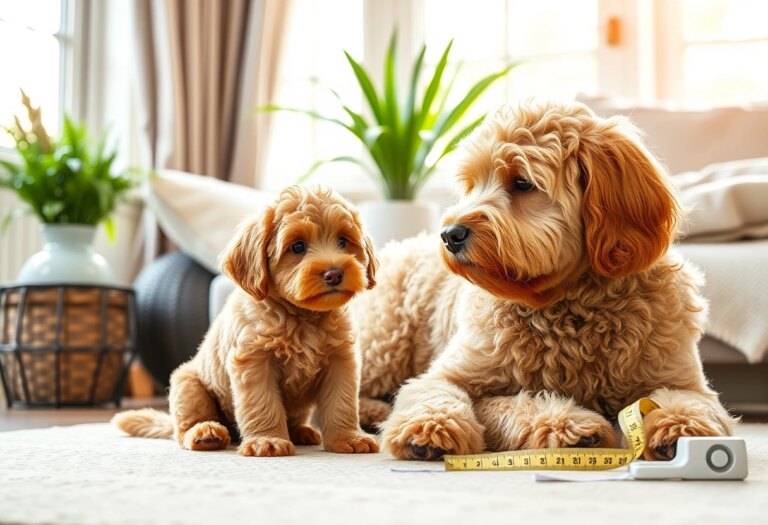

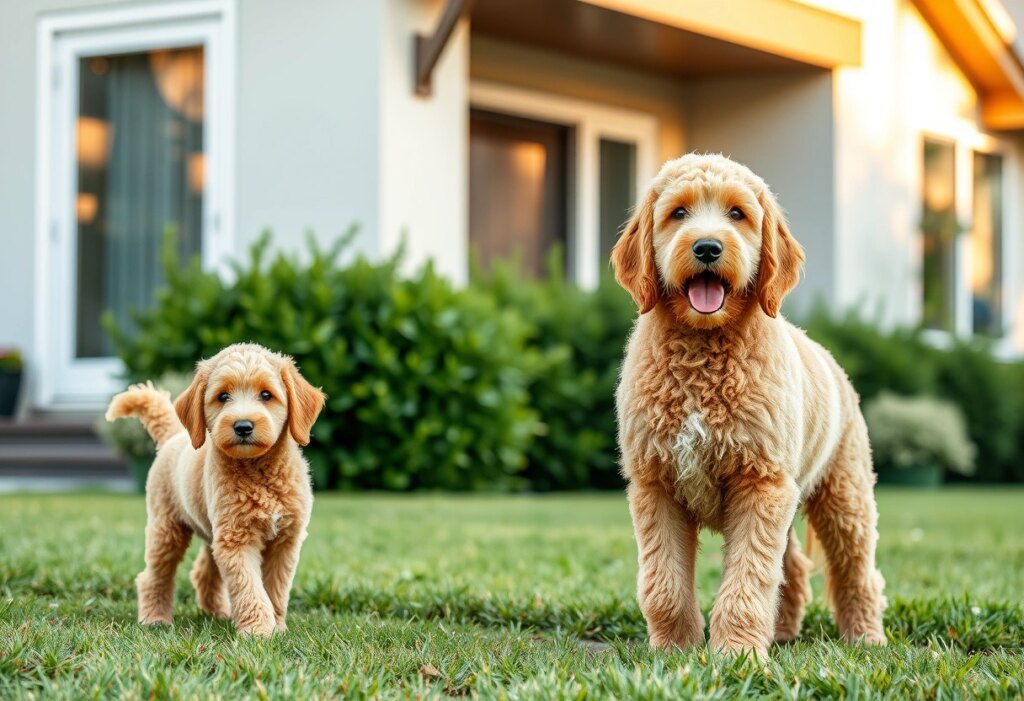
Goldendoodle size can change your daily routine more than many first-time buyers expect. A Mini may fit neatly beside your desk and under an airplane seat, while a Medium can bring a sturdier hiking partner, a larger appetite, and a little more dog to manage during grooming. The best choice depends on your home, travel habits, activity level, budget, and comfort with uncertainty around adult growth.
Breeder labels are useful starting points, not guarantees. Two puppies called “Mini” may mature at different heights and weights, especially when their Poodle parents come from different size lines. Before sending a deposit, compare expected adult proportions, not just the label on the litter page.
Key Takeaways
- A Mini Goldendoodle often suits smaller homes, frequent travelers, and people who want a lighter dog to lift or carry.
- A Medium Goldendoodle may be a better match for active households that want a more substantial walking, hiking, or outdoor companion.
- Parent sizes, growth records, and health testing provide better clues than a cute puppy’s current weight.
- Food and equipment may cost more for a larger dog, but grooming, veterinary care, and health risks are not determined by size alone.
- Ask breeders for realistic adult ranges and a clear explanation of how they estimate puppy growth.
What Do “Mini” and “Medium” Goldendoodle Sizes Actually Mean?
Goldendoodle size labels do not come from one universally enforced breed standard. Breeders commonly use “Mini” for a smaller cross and “Medium” for a dog between Mini and Standard sizes, but the cutoff points can vary. One program may describe a 25-pound dog as Medium, while another may place that same dog at the upper end of its Mini range.
Many breeders use approximate ranges such as these:
| Type | Common adult height | Common adult weight | Typical household fit | Price Tier |
|---|---|---|---|---|
| Mini Goldendoodle | About 13 to 17 inches at the shoulder | About 15 to 35 pounds | Compact homes, easier lifting, lighter travel gear | $$ |
| Medium Goldendoodle | About 17 to 21 inches at the shoulder | About 30 to 50 pounds | Active homes wanting a sturdier companion | $$$ |
| Standard Goldendoodle | Often over 21 inches at the shoulder | Often over 50 pounds | Roomier homes and owners prepared for a larger dog | $$$ |
These figures are planning estimates, not promises. A puppy’s eventual Goldendoodle adult weight can land above or below the breeder’s projected range. Growth also happens in stages, so a lanky adolescent may look nothing like the compact adult you pictured.
Choose the dog you can comfortably care for at the top of the estimated range, not the smallest number on the chart.
Ask how the breeder defines each size category, which parent contributes the smaller frame, and how past puppies from the same pairing matured. A careful answer should include uncertainty rather than a perfectly confident prediction.
How Much Room, Exercise, and Travel Flexibility Will Your Dog Need?
The practical side of Goldendoodle size shows up in ordinary moments. A Mini may curl beside your legs in a compact living room, yet that does not make the dog low-energy. These dogs still need sniffing walks, training games, coat care, and social time. Small body does not equal small personality.
A Medium usually needs more floor space for indoor play and more room in the car. You may notice the difference when the dog turns around in a crate, stretches across the back seat, or brings muddy paws through the entryway. None of that rules out an apartment, but your walking routine and storage setup need to be realistic.
Home life
- Measure the spot where the crate will sit, then leave enough room for a dog to stand, turn, and stretch.
- Consider stairs and flooring. A slippery hallway can be awkward for any puppy, especially a growing dog with little traction.
- Think about your furniture. A Medium can occupy an entire sofa cushion, while a Mini may still claim the same space through sheer confidence.
Car and travel
For road trips, measure the usable cargo or back-seat area rather than guessing from the vehicle’s advertised capacity. A Mini is easier to lift into a car after surgery, illness, or a muddy park visit. A Medium may need a sturdier harness, a roomier travel crate, and a better plan for keeping people and dog comfortable on long drives.

Air travel rules change by airline and aircraft, so never buy a puppy based only on the hope that the dog will fit beneath a seat. Check current carrier requirements before making travel plans.
For a playful seasonal touch in a yard, the Best of Breed HHS Summer Crown Garden Flag is a cheerful decoration rather than a pet product. I like that it adds personality near a porch without putting clothing or accessories on a dog. The fabric feels light, so I would place it where sprinklers and heavy wind are not constant problems. My small complaint is that thin outdoor flags can crease in shipping and may need a quick smoothing before they look tidy.

- Flag is 12″ x 17″
- Image is printed on both sides of flag.
- Flag is made with 2 pieces of fabric sewn back to back
What Can Parent Breeds Tell You About Your Puppy’s Adult Size?
Parent size gives you one of the clearest clues about Goldendoodle size, but it cannot produce an exact adult measurement. A puppy from a smaller Golden Retriever and smaller Poodle pairing may mature differently from a puppy with a larger Golden Retriever and Standard Poodle parent, even if both puppies are sold under the same label.
Ask for the actual height and weight of both parents, not only terms such as “petite” or “medium.” Also ask about grandparents if the breeder has those records. Family patterns can reveal whether the litter tends to mature narrow and light or broad and sturdy.
The Poodle parent’s classification matters. The American Kennel Club’s Poodle standard describes Standard Poodles as more than 15 inches at the shoulder. That detail helps explain why a Goldendoodle from a Standard Poodle line may grow much larger than a puppy from a smaller Poodle line.
Still, genetics are not a measuring tape. Nutrition, illness during growth, sex, and the mix of inherited traits all affect the final result. A breeder who says, “This puppy will weigh exactly 32 pounds,” is offering more certainty than biology allows.
Useful growth information to request
- Weight records from birth through the current age.
- Recent measurements from the floor to the top of the shoulder.
- Adult weights of older siblings from earlier litters.
- The breeder’s method for estimating adult size.
- A note explaining whether the puppy is tracking high, low, or near the middle of the litter.
Will a Mini or Medium Fit Your Budget and Care Routine?
Goldendoodle size can affect some expenses, but it does not decide every cost. A Medium may eat more food and need larger beds, crates, car barriers, and raincoats. A Mini may use less food, yet a dense, fast-growing coat can still create a sizable grooming bill.
Grooming deserves close attention. Doodle coats can mat close to the skin, especially behind the ears, under the legs, around the collar, and near the tail. Coat texture matters as much as body size. A small dog with a thick, curly coat may take longer to brush than a larger dog with a looser coat.
Plan for daily handling practice from puppyhood. Touch the paws, lift the ears gently, run a comb through the beard, and reward calm behavior. For owners preparing to manage trims at home, these grooming kit ideas for Mini Goldendoodle haircuts can help you compare tools before buying equipment.

Veterinary planning needs the same balanced view. Larger dogs may have different orthopedic considerations, while smaller dogs can have their own dental or injury concerns. Size alone does not predict health, and no Doodle should be selected on body weight without reviewing health testing in the parent dogs.
Training supplies also change with the dog. A Medium may need a stronger long line and a larger exercise pen. A Mini may need smaller treat pieces and a lighter leash that does not drag across the floor. In both cases, reward-based training is the kindest route and usually the easiest for an eager, people-focused Doodle to understand.
For a holiday outfit, the Goldendoodle 4th of july patriotic golden doodle dog T-Shirt is best treated as a short photo-session item. The fabric is the sort of light layer I would put on only after checking the neck and leg openings for rubbing. It is simple to pull on, though a wiggly dog can make any shirt feel fussy. The pet peeve is sizing uncertainty, since a dog’s chest and coat thickness can make the printed size less useful than measuring first.

How Can You Choose a Responsible Breeder and the Right Puppy?
A responsible breeder will discuss Goldendoodle size without pretending the forecast is exact. They should explain the parent pairing, show health records, describe the puppies’ daily handling, and ask questions about your home. A breeder who only asks how quickly you can pay is giving you useful information too.
Bring a short list to your call:
- What are the parents’ measured heights and current weights?
- What adult weight range did earlier puppies from this pairing reach?
- Which orthopedic, eye, heart, and inherited-disease screenings were completed?
- Can I see veterinary records and growth charts?
- How are puppies introduced to grooming, household sounds, crates, and gentle handling?
- Which puppy seems best suited to a quieter home, active family, or frequent traveler?
Watch how the breeder describes temperament. A bold puppy is not automatically the best fit for a busy household, and a quieter puppy is not automatically timid. Ask what the breeder has observed over several weeks, then match that information to your daily life.
A Halloween-themed option, the Goldendoodle Ghost and Boba Cute Halloween Dog Humor T-Shirt, works as a fun example of why fit matters more than the label. On a curly-coated dog, a shirt can catch hair or bunch near the shoulders if the cut is too snug. The print gives a playful photo-ready look, but I would use it for supervised, short periods and remove it for crate time, sleep, or rough play.

Mini or Medium: Which One Should You Choose?
Choose a Mini if you value easier lifting, compact travel, and a smaller physical footprint, while still accepting the exercise and grooming needs of a bright Doodle. Choose a Medium if you want a sturdier dog for longer outdoor outings and have room for larger equipment, more vigorous movement, and a bigger adolescent body.
The right Goldendoodle size is the one that fits your least convenient day. Picture a rainy morning, a full car, a grooming appointment, a sick dog who needs help climbing stairs, and a puppy who has not yet learned polite greetings. If your plan still works, your choice is probably realistic.
Do not pick based on a puppy’s current fluff or paw size alone. Review the parents, study the records, meet the litter if possible, and leave room for natural variation. A well-matched dog is far more rewarding than a perfectly predicted number.
Frequently Asked Questions
Is a Mini Goldendoodle always easier to care for than a Medium Goldendoodle?
Not always. A Mini is easier to lift and may use smaller supplies, but coat density, energy level, training needs, and temperament can create just as much daily work. Ask about the puppy’s coat and behavior rather than judging care needs by size alone.
How reliable is a breeder’s Goldendoodle size estimate?
It is a helpful estimate, not a guarantee. The prediction is stronger when the breeder has accurate parent measurements, growth records, and adult data from related puppies. Plan for the high end of the stated range and ask what happens if the puppy grows beyond it.
What should I measure before bringing home a Goldendoodle?
Measure the crate location, car space, doorway width, stair route, and storage area for food and grooming supplies. Leave enough room for the dog to stand, turn, stretch, and move safely. Also check local grooming and boarding facilities for size limits.
Does Goldendoodle adult weight predict health or exercise needs?
No. Weight helps you plan equipment and food, but it does not predict temperament, stamina, coat difficulty, or overall health by itself. Review parent health testing, maintain a lean body condition with veterinary guidance, and adjust exercise as the puppy grows.