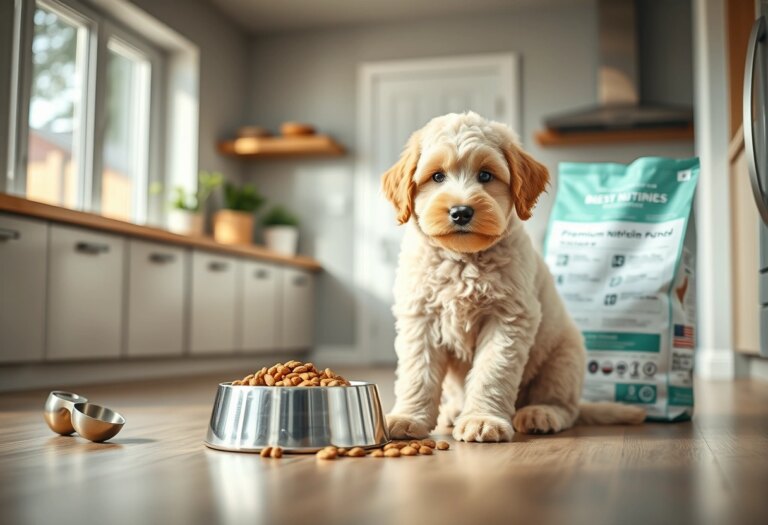
Mini goldendoodle puppy food needs to hit a very specific nutritional target, since these pups grow fast in their first year but are only expected to reach 15 to 35 pounds as adults, which is a completely different growth curve than a large-breed dog. Get the ratios wrong and you risk everything from soft stools to joint problems down the road. I’ve spent years fielding questions from doodle parents who stand in the pet food aisle completely overwhelmed, staring at Royal Canin bags next to Hill’s Science Diet and Purina Pro Plan, wondering which one actually deserves a spot in their kitchen. This article breaks down exactly how these brands stack up, what your vet actually wants you to look for, and which red flags should send you running the other way.
Why Mini Goldendoodle Puppies Have Unique Nutritional Needs
A mini goldendoodle puppy isn’t a small version of a standard goldendoodle. Genetically and metabolically, she’s her own animal with her own growth timeline. Small-to-medium breed puppies mature faster than giant breeds, often reaching most of their adult height within 10 to 12 months. That compressed growth window means every meal has to be nutrient-dense without pushing growth too quickly, since rapid bone development in a small frame can still stress joints if calorie intake outpaces what the skeleton can handle. This is one reason mini goldendoodle puppy food formulated for small or medium breeds tends to perform better than a generic “all life stages” bag grabbed off the shelf without much thought.
Coat quality matters too. Doodles carry the Poodle’s curl gene, and a diet low in quality fats and omega fatty acids shows up fast as dry, brittle, or dull fur. If you’re already dealing with a wiry or cottony coat texture, pairing good nutrition with the right grooming routine makes a real difference, and checking out a detangler spray built for wet Goldendoodle coats can save you a lot of frustration during bath time regardless of which food you land on.
Royal Canin Breed-Specific Formulas: What’s Actually in the Bag
Royal Canin built its reputation on breed-specific and size-specific formulas, and for small breed puppies, that means kibble sized small enough for tiny jaws, plus a nutrient profile aimed at supporting quick metabolisms. Their Small Puppy formula leans on chicken meal or chicken by-product meal as a primary protein source, with fat levels tuned to support the higher energy needs small breed puppies burn through relative to their body size. The kibble itself is worth mentioning too, since Royal Canin puts real engineering into shape and texture, something that matters for a mini goldendoodle puppy still learning to chew properly.

On the plus side, Royal Canin formulas are backed by feeding trials and tend to have consistent quality control across batches. On the downside, some of their formulas use by-product meals and corn gluten meal, which aren’t harmful but aren’t everyone’s preference if you’re chasing a “cleaner” ingredient list. Price also sits at a premium tier compared to some vet-recommended alternatives, and a handful of doodle owners report slightly looser stools when transitioning onto Royal Canin, likely tied to fat content rather than any inherent flaw. It’s a solid option, just not automatically the best fit for every pup.
Vet-Recommended Alternatives: Hill’s Science Diet and Purina Pro Plan
When vets recommend alternatives to Royal Canin, Hill’s Science Diet and Purina Pro Plan come up constantly, and for good reason. Both brands employ board-certified veterinary nutritionists on staff, run AAFCO-compliant feeding trials rather than just lab-formulating to meet minimum nutrient profiles on paper, and publish their calcium-to-phosphorus ratios openly, which matters enormously for joint development in growing puppies. The World Small Animal Veterinary Association specifically recommends choosing brands that employ full-time nutritionists and conduct feeding trials, and both Hill’s and Purina Pro Plan check those boxes cleanly.
Purina Pro Plan’s Puppy Small Breed formula uses real chicken as the first ingredient and includes DHA, an omega-3 fatty acid pulled from fish oil that supports brain and eye development during those critical early months. Hill’s Science Diet takes a similar approach with chicken meal and a controlled fat-to-protein ratio designed to prevent excess weight gain during the growth phase. If you want a dependable everyday option that won’t break the budget, Purina ONE Plus Digestive Health Dry Dog Food is another Purina line worth a look, particularly for pups with sensitive stomachs, since it’s formulated with prebiotic fiber to support gut health.

- Complete and balanced digestive care dog food with digestive support for adult dogs with sensitive stomachs
- Highly digestible adult dog food formula enriched with probiotics for dog digestive support
- Real chicken is the first ingredient in our high protein dog food, which includes natural glucosamine sources for joint …
Where these vet-recommended brands sometimes fall short of Royal Canin is kibble sizing. Neither Hill’s nor Purina Pro Plan gets quite as granular with breed-specific kibble shapes, so a mini goldendoodle puppy food bowl might contain slightly larger pieces than the tiny kibble Royal Canin engineers specifically for small mouths. It’s a minor tradeoff most puppies adjust to within a week or two.
Whatever bag you choose, look for the AAFCO statement confirming the food is “formulated to meet the nutritional levels established for growth” or backed by an actual feeding trial, not just a lab formulation. That single line on the label tells you more than any marketing claim on the front of the bag.
Comparing the Top Mini Goldendoodle Puppy Food Options
Here’s how the leading options stack up when you put them side by side. Pay close attention to the calcium-phosphorus ratio and DHA inclusion, since those two factors matter most for a growing mini goldendoodle puppy’s joints and brain development.

| Brand/Formula | Primary Protein | DHA Included | Kibble Size | Best For | Price Tier |
|---|---|---|---|---|---|
| Royal Canin Small Puppy | Chicken meal | Yes | Very small, breed-engineered | Picky eaters, small jaws | $$$$ |
| Purina Pro Plan Small Breed Puppy | Chicken (whole) | Yes | Small-medium | Balanced everyday nutrition | $$$ |
| Hill’s Science Diet Small Paws | Chicken meal | Yes | Small-medium | Sensitive digestion | $$$ |
| Purina ONE Plus Digestive Health | Chicken (whole) | No | Medium | Budget-conscious households | $$ |
Feeding Schedules and Portion Guidance by Weight
Portion control matters as much as ingredient quality, maybe more. AAFCO’s puppy growth nutrient profiles assume you’re feeding an amount appropriate for expected adult size, and for a mini goldendoodle puppy expected to land between 15 and 35 pounds at maturity, that usually breaks down to roughly the following, adjusted based on your specific puppy’s growth curve and your vet’s guidance:
- 8 to 12 weeks old: Four small meals daily, roughly 1/4 to 1/2 cup per meal depending on projected adult size
- 3 to 6 months old: Three meals daily, gradually increasing to 1/2 to 3/4 cup per meal
- 6 to 12 months old: Two meals daily, transitioning toward adult portion sizes based on body condition
- 12+ months: Transition to adult formula once growth plates close, typically confirmed at a vet visit
Free-feeding is generally discouraged for mini goldendoodle puppies, since it makes it much harder to track appetite changes or catch early signs of illness. Scheduled meals also help with house training, since what goes in on a schedule tends to come out on a schedule too. Serving from a sturdy, appropriately-sized bowl matters more than people expect, and something like the Miaosical Brand Replacement Bowl works well for puppies still growing into their adult jaw size, since it’s easy to clean and doesn’t tip over during enthusiastic mealtimes.

- Only fit for Miaosical brand feeders
- Miaosical 304 Stainless Steel Bowl Replacement
- ONLY For Miaosical brand automatic cat feeders only,not fit for other brand’s feeders.
Red Flags to Avoid When Choosing Vet-Recommended Dog Food
Not every bag marketed toward puppies deserves a place in your pantry. Boutique brands pushing exotic proteins like kangaroo or bison, alongside grain-free formulas heavy on peas and lentils, drew serious scrutiny after the FDA’s 2018 investigation linking certain grain-free diets to a potential increased risk of dilated cardiomyopathy (DCM) in dogs. The connection isn’t fully settled science, but enough evidence exists that most vets now steer clients away from boutique grain-free formulas unless there’s a diagnosed medical reason to avoid grains specifically.
A quick checklist before you commit to a bag long-term:
- Confirm the label states the food meets AAFCO nutrient profiles for growth, ideally backed by feeding trials rather than formulation alone
- Avoid formulas where peas, lentils, or potatoes appear in the first five ingredients ahead of a named animal protein
- Check that the brand employs a board-certified veterinary nutritionist, information usually listed on the company website
- Skip anything marketed primarily on trendy buzzwords rather than nutritional transparency
- Ask your vet directly whether your specific mini goldendoodle puppy has any needs that change the equation, like food sensitivities or slow weight gain
Whichever mini goldendoodle puppy food you settle on, plan to reassess around the one-year mark. Growth rates, activity levels, and even coat texture can shift as your pup matures, and what worked at four months might need tweaking by month ten. If you’re also weighing how a mini goldendoodle’s care needs compare to other family dog options, this Goldendoodle vs Golden Retriever maintenance comparison is worth a read alongside your food research, since coat and grooming demands often factor into the same household decisions.
Treats count toward daily calorie intake too, and it’s easy to overlook that when portioning main meals. Single-ingredient options like Canine Cravers Single Ingredient Dog Treats make it simple to reward training without introducing fillers or mystery ingredients that could upset a sensitive puppy stomach.

- ALL NATURAL DOG TREATS: Your pets deserve the best! Our healthy dog treats are made using 1 simple human grade ingredien…
- TURKEY. ONLY TURKEY: Don’t let your dog eat preservatives, additives and by-products. Our protein rich Turkey strips are…
- DOGS & CATS LOVE IT: Our freshly made treats will leave your pup begging for more! The 100% natural ingredients provide …
Frequently Asked Questions
Is Royal Canin puppy food actually worth the higher price?
For many mini goldendoodle puppies, yes, especially if your pup has a small mouth or picky eating habits, since Royal Canin’s breed-specific kibble shapes and feeding trial backing offer real value. That said, vet-recommended brands like Purina Pro Plan and Hill’s Science Diet deliver comparable nutrition at a lower price tier, so it comes down to your budget and your puppy’s individual preferences rather than one brand being objectively superior.
How much should I feed my mini Goldendoodle puppy each day?
Portions depend on age, projected adult weight, and activity level, but most mini goldendoodle puppies eat between three and four small meals daily until around six months old, then transition to two meals daily. Always follow the feeding chart on your specific bag of mini goldendoodle puppy food as a starting point, then adjust based on body condition and guidance from your veterinarian.
Should I avoid grain-free food for my Goldendoodle puppy?
Most veterinarians recommend steering clear of boutique grain-free formulas for healthy puppies, given the FDA’s 2018 report linking certain grain-free diets to a potential risk of dilated cardiomyopathy. Unless your vet has diagnosed a specific grain sensitivity, a grain-inclusive formula from an established brand with feeding trial data is generally the safer long-term choice for a mini goldendoodle puppy’s heart health.
When should I switch my Mini Goldendoodle from puppy food to adult food?
Most mini goldendoodle puppies can transition to adult formula between 10 and 12 months old, once growth plates have closed and weight gain has stabilized. Your veterinarian can confirm the right timing at a wellness visit, since some puppies mature slightly faster or slower depending on their individual size and Poodle-to-Retriever ratio.