

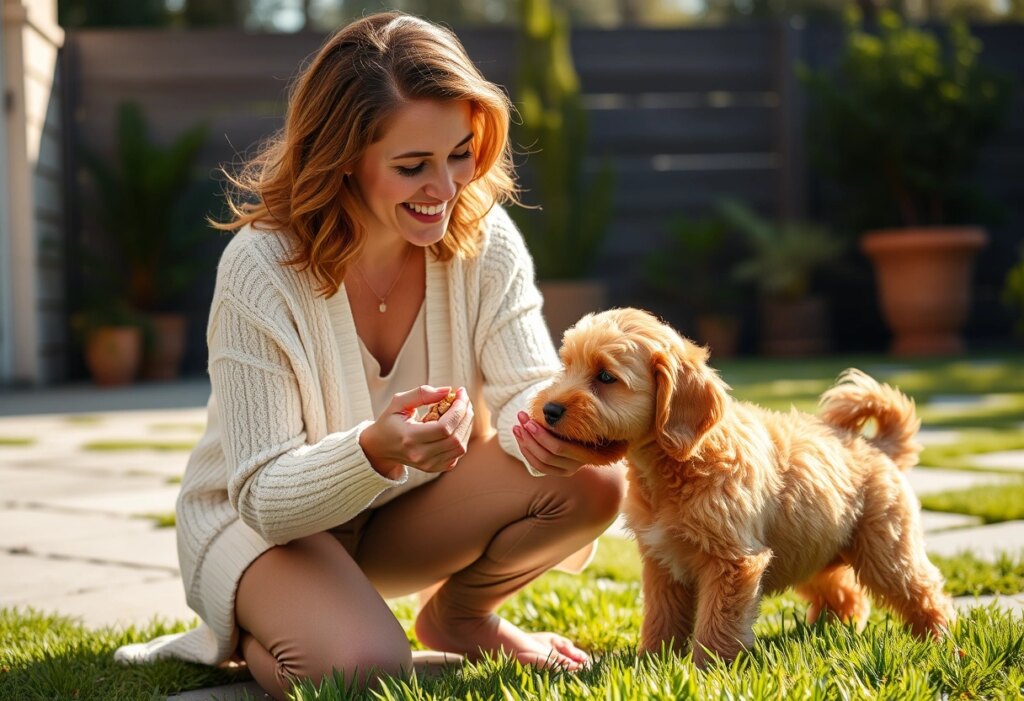
You can potty train a Goldendoodle puppy in as little as two to four weeks if you commit to a tight schedule, use a crate correctly, and reward success the moment it happens. There’s no magic trick here, just consistency, timing, and a little patience while your puppy’s bladder and brain catch up with each other. If you’ve been Googling frantically after your third carpet cleanup this week, take a breath. This breed is wired to learn fast, and I’m going to walk you through exactly how to use that to your advantage.
I’m Emily Cooper, and I’ve spent years writing about Doodle behavior and raising my own ridiculously food-motivated Goldendoodle. Housetraining felt like chaos at first, then it clicked once I understood the actual mechanics behind it. That’s what this guide is: the mechanics, laid out in order, so you can skip the guesswork.
Why Goldendoodles Respond Fast to Potty Training
Here’s the good news baked right into the breed. Goldendoodles are a cross of Poodles and Golden Retrievers, two breeds that both rank near the top of canine intelligence research. Psychologist Stanley Coren’s well-known studies on working and obedience intelligence placed Poodles in the top tier of trainable breeds, and Golden Retrievers aren’t far behind. When you combine those genetics, you get a puppy that picks up patterns quickly and genuinely wants to please the person feeding it.
This matters for housetraining because the process is really pattern recognition dressed up as a life skill. Your puppy needs to connect “outside, on grass, after I wake up” with “this is where I’m supposed to go.” A quick learner catches onto that connection faster than a stubborn or independent breed might. That said, intelligence doesn’t mean a puppy arrives pre-programmed. You still have to teach the pattern deliberately, every single day, for several weeks straight. If you’re also working through other training basics at this stage, our guide on better training methods that work covers techniques that pair well with housetraining, especially if you’re trying to correct unwanted chewing or nipping at the same time.
One thing I hear a lot from new Goldendoodle owners is confusion about why their puppy seems smart in every other way but still has accidents. The intelligence helps with speed of learning, not with bladder control. A 10-week-old puppy simply doesn’t have the physical capacity to hold it for hours, no matter how clever she is. That brings us to the schedule, which is really the backbone of the entire process.
Setting a Consistent Schedule to Potty Train Goldendoodle Puppies
If you only take one thing from this article, make it this: a strict schedule is what makes you able to potty train Goldendoodle puppies quickly. The ASPCA’s housetraining guidelines recommend bathroom breaks every one to two hours for puppies under 12 weeks old, and that’s not an exaggeration for effect. Young puppies have small bladders and even smaller impulse control, so frequent trips outside aren’t optional extras, they’re the actual training mechanism.
Here’s a rough timing framework that works well for most Goldendoodle puppies:
- First thing in the morning, immediately after waking up
- Within 15 minutes after eating or drinking
- After any nap, even a short one
- After vigorous play or excitement
- Right before bedtime
- Every 1-2 hours during waking hours, scaled slightly based on age
A general rule of thumb some trainers use is one hour of bladder control per month of age, up to about eight or nine hours overnight once the puppy is older. So a 3-month-old Goldendoodle might manage three hours between breaks during the day, but still needs a middle-of-the-night trip if she’s younger than that. Don’t fight this biology. Pushing a young puppy past her limit just sets up more accidents and more frustration for both of you.

Take her to the exact same spot outside every time if you can. The scent cue helps reinforce the behavior, and it also means you’re not accidentally training her to think your whole backyard is fair game. Use a consistent phrase too, something like “let’s go potty,” said in the same calm tone each time. Over a few weeks, that phrase becomes its own trigger.
Crate Training and Confinement Strategy
Crate training gets a bad reputation from people who picture it as punishment, but used correctly, it’s one of the fastest ways to prevent indoor accidents while your puppy learns bladder control. Dogs have a natural instinct not to soil the space where they sleep, so a properly sized crate becomes a built-in incentive to hold it until the next outdoor break.
The crate needs to be the right size, which trips up a lot of new owners. Too big, and your puppy will just use one corner as a bathroom and sleep in the other. It should be just large enough for her to stand up, turn around, and lie down comfortably, nothing more. Many adjustable crates come with divider panels so you can expand the space as your Goldendoodle grows, which saves you from buying three crates over the course of a year.
Confinement doesn’t have to mean a crate 24/7. An exercise pen or a gated-off section of a tiled room works too, especially during the day when you’re home but can’t watch her every second. The goal is limiting her access to the whole house until she’s proven she understands where bathroom breaks happen. Expanding her freedom too early is probably the single most common mistake I see, and it usually leads to regression.
Puppies also go through a teething phase right around the same months you’re housetraining, and a lot of chewing happens inside crates out of boredom or discomfort. A Training Tie Down – Short Tether for Dogs & Teething can help manage this overlap by giving your puppy a designated, controlled spot to settle with a chew toy during supervised downtime, which reduces the restlessness that sometimes leads to accidents from anxious pacing.

- PREVENT CHEWING – Made with heavy duty vinyl coated wire rope, like a tie-out but lighter and more flexible
- CRATE TRAINING ALTERNATIVE: Easier, smaller, and less than half the price of crates or xpens / playpens / indoor exercis…
- SIZING: Suitable for dogs small to extra large. Not suitable for toy breeds (less than 12 pounds)
Keep crate sessions reasonable for the puppy’s age too. A good budget-friendly crate setup paired with short, structured confinement periods will do more for your housetraining timeline than any premium gadget on the market.
Positive Reinforcement Techniques That Actually Work
Timing is everything when you’re trying to potty train Goldendoodle puppies through positive reinforcement. The reward needs to happen within about five seconds of the successful bathroom break, not after you walk back inside, not after you’ve both settled on the couch. Five seconds is roughly the window a puppy’s brain uses to connect an action with a consequence. Wait any longer, and she may associate the treat with something else entirely, like sitting calmly by the door.
Keep small training treats in a pocket or a clip-on pouch you wear every time you head outside. The second she finishes, mark it with an enthusiastic “yes!” or a clicker if you’re using one, then deliver the treat immediately. Pair it with calm praise, not a wild celebration that gets her too excited to finish if she wasn’t quite done.
Puppies don’t learn from being scolded after the fact. They learn from being rewarded at the exact moment they get it right. If you missed the moment, you missed the lesson, so just reset and wait for the next opportunity.
This reward window matters just as much for other training goals, by the way. Readers often ask about correcting unwanted habits like nose-tapping or shouting corrections, and the honest answer is that better training methods that actually work rely on this exact same timing principle rather than punishment after the fact. Positive, immediate feedback consistently outperforms correction-based approaches, and it builds trust instead of eroding it.

If you’re also managing a household with young kids who want to help with training duties, giving them a specific job, like holding the treat pouch or saying the reward phrase, keeps everyone involved without confusing the puppy with too many cues at once. Some families even make a small ritual out of the first successful outdoor potty trip, marking the milestone the way you might mark any first for a new puppy. If you’re hunting for a low-key way to celebrate training wins with kids on a rainy indoor day, something building-focused like the LEGO Creator 3 in 1 Pirate Ship Building Set gives everyone a shared project while the puppy naps off her last potty break.

- 3 in 1 Set – This LEGO Creator pirate-themed set includes 3 models in 1: a classic Pirate Ship toy, rustic Pirates’ Inn,…
- Pirate Ship Features – The pirate ship toy includes an opening cabin roof and wall, a platform for keeping watch, and ro…
- Pirate Minifigures – Set includes 2 pirate minifigures in full costume with sabers, 1 deckhand sailor, and buildable sha…
Comparing Housetraining Approaches
Different methods work better depending on your schedule, your home layout, and your puppy’s temperament. Here’s how the main approaches stack up against each other.
| Method | Best For | Typical Timeline | Equipment Needed | Price Tier |
|---|---|---|---|---|
| Crate Training | Owners home for frequent breaks | 2-4 weeks | Properly sized crate, bedding | $$ |
| Puppy Pads | High-rise apartments, limited outdoor access | 4-6 weeks | Pads, holder tray | $ |
| Tethered Supervision | Active households, multiple caregivers | 3-5 weeks | Short tether, treat pouch | $$ |
| Bell Training | Puppies past basic housetraining basics | 1-2 weeks (as add-on) | Door bells or sensor mat | $$$ |
| Professional Trainer Assist | Busy households, repeated regression | Varies, often faster | None (service-based) | $$$$$ |
Most families find that combining crate training with tethered supervision during the day gives the fastest, most reliable results without requiring a premium investment in equipment or a professional trainer. For a deeper look at how Goldendoodle learning speed compares to other smart breeds, our article on Goldendoodle vs German Shepherd intelligence and training ease breaks down how trainability translates into real-world housetraining outcomes.
Troubleshooting Regression and Accidents
Even puppies who seemed fully housetrained sometimes backslide, and it’s worth understanding why before you assume the training failed. Regression usually traces back to one of a few common triggers.
Anxiety or stress is a frequent culprit, especially after a move, a new pet in the home, or a change in your work schedule. Puppies pick up on disruption fast, and bathroom habits are often the first thing to slip when a dog feels unsettled. Giving your Goldendoodle a predictable routine, even amid other changes, helps smooth this out within a week or two.
Diet changes can also throw things off. Switching food brands too quickly, feeding too many table scraps, or introducing new treats can upset digestion and lead to looser stools or more frequent urges that your puppy hasn’t learned to signal yet. Transition any food change over seven to ten days, mixing old and new food gradually, to avoid this entirely.
Medical issues deserve real attention here too. Urinary tract infections, parasites, and certain digestive conditions can cause sudden accidents in a puppy who was previously doing fine. If regression happens suddenly, lasts more than a few days, or comes with other symptoms like increased thirst, lethargy, or straining, a vet visit is the right call rather than assuming it’s a training lapse. The American Kennel Club’s house-training resources offer additional detail on recognizing when accidents signal something medical rather than behavioral.
Whatever you do, avoid punishing accidents after the fact. Rubbing a nose in a mess or yelling after discovering a puddle doesn’t teach anything useful, it just teaches your puppy to be afraid of you finding evidence, which sometimes leads to hiding accidents in less obvious spots. If you’re trying to potty train Goldendoodle puppies successfully, patience during setbacks matters just as much as consistency during the easy stretches.
On a lighter note, once your puppy is fully trained and settling into her role as part of the family, a lot of owners like marking the milestone with something sentimental for the holidays. If your household already has a dog-loving tradition around the tree, a Personalized German Shepherd Ornaments for Christmas Tree style keepsake (available in various breed and name customizations) makes a nice way to commemorate the first year, accidents and all.

- CELEBRATE YOUR PUP: Bring holiday cheer with dog ornaments for Christmas tree and personalized dog ornaments that captur…
- PERSONALIZED PET KEEPSAKE: Customize your personalized dog ornaments for Christmas tree or personalized pet Christmas or…
- GIFT FOR DOG LOVERS: Suitable for dog Christmas gifts or gifts for dog lovers, these ornaments make thoughtful presents …
Key Takeaways
- Goldendoodles learn fast due to high trainability inherited from both Poodle and Golden Retriever lines
- Puppies under 12 weeks need bathroom breaks every 1-2 hours, following ASPCA guidelines
- Crate training works by leveraging a puppy’s natural instinct to avoid soiling her sleeping space
- Rewards must come within five seconds of success to effectively reinforce the behavior
- Regression often points to anxiety, diet changes, or medical issues rather than a training failure
Frequently Asked Questions
How long does it typically take to potty train a Goldendoodle puppy?
Most Goldendoodle puppies become reliably housetrained within two to four weeks when owners follow a consistent schedule and use crate training correctly. Full reliability, including overnight control, often takes a bit longer, sometimes up to four months, since bladder maturity plays as big a role as learning the behavior itself.
What is the fastest way to housetrain puppy fast without a crate?
If a crate isn’t an option, tethered supervision combined with a strict every-hour-or-two schedule works nearly as well. Keeping your puppy within arm’s reach using a short tether lets you catch early signals, like sniffing or circling, so you can rush outside before an accident happens.
Why does my Goldendoodle puppy have accidents right after coming inside from outside?
This usually happens when the outdoor trip ended too soon, before the puppy finished emptying her bladder, often because she got distracted by sounds or smells. Give her a few extra minutes outside after the first attempt, and avoid heading back in immediately after the first small success.
Is it normal for a Goldendoodle puppy’s crate training schedule to need adjusting as she grows?
Yes, bladder capacity increases steadily with age, so a crate training schedule that worked at eight weeks will feel too frequent by four months. Gradually extend the time between breaks as your puppy shows she can hold it longer, usually adding 30 to 60 minutes every couple of weeks.


