


If you’re brushing your Goldendoodle every single day and still finding mats hiding behind the ears or tangled up in the armpits, you’re not doing anything wrong. You just might be reaching for the wrong tool at the wrong stage of the job. The short answer: a slicker brush handles the surface work, but an undercoat rake is the tool that actually pulls out the dense, loose fur causing most of the shedding and matting underneath.
Neither tool replaces the other. A slicker brush and an undercoat rake solve two different problems, and Goldendoodle owners who use only one usually end up frustrated by the results. Below, I’ll walk through the coat science behind why your Doodle mats so easily, break down what each tool is genuinely good at, and give you a weekly routine that keeps shedding, mats, and skin irritation under control without turning bath day into a wrestling match.
Why Goldendoodle Coats Mat So Easily in the First Place
Goldendoodles aren’t one uniform coat type. Depending on the generation, they carry different ratios of Poodle curl to Golden Retriever undercoat, and that ratio determines how much your dog sheds and how fast mats form.
- F1 Goldendoodles (50% Poodle, 50% Golden Retriever) often carry the heaviest undercoat and shed the most of any generation.
- F1B Goldendoodles (bred back to a Poodle) usually have curlier, lower-shedding coats, but the curl itself traps loose hair, which leads to matting even though shedding looks minimal.
- F2B Goldendoodles land somewhere in between, with wavy to curly coats that still hold onto a noticeable undercoat layer.
According to coat genetics data referenced by doodle breed organizations, more than 60% of Goldendoodles inherit a thick, curl-prone undercoat that’s genetically predisposed to matting if it isn’t managed correctly. That undercoat sits below the visible topcoat, which is exactly why a quick surface brushing can look fine one day and hide a painful mat the next. If you’re trying to figure out which generation gives you the easiest coat to maintain, this breakdown of which Goldendoodle generation sheds the least is a useful next stop.
A coat that looks brushed on the surface can still be matted at the skin. Undercoat buildup is the hidden cause of most “sudden” mats owners find during bath time.
Slicker Brush Breakdown: Great for Daily Upkeep, Not Deep Shedding
A slicker brush is that flat paddle covered in fine, slightly bent wire bristles. It’s designed to glide through the topcoat, break up small tangles, and smooth curls into place. For daily or every-other-day maintenance, it’s genuinely hard to beat.
Where it struggles is density. A slicker brush works the surface layer of the coat. It doesn’t reach deep enough to consistently pull out the packed undercoat fur that builds up close to the skin, especially on F1 and F2B Goldendoodles with heavier double coats.
Slicker Brush Pros:

- Fast, easy daily detangling that keeps curls from felting together
- Good finishing tool after a bath or full grooming session
- Gentle enough for the face, legs, and ears with light pressure
- Widely available and easy for beginners to use correctly
Slicker Brush Cons:
- Doesn’t remove dense undercoat, especially during seasonal shedding
- Can miss mats forming closer to the skin
- Overuse with heavy pressure can cause brush burn on sensitive skin
- Not sufficient on its own for heavy-shedding coat types
A solid example of a dual-purpose option is the Self-Cleaning Deshedding Dog Cat Brush, Thick Double Coat, which pairs slicker-style bristles with a retraction button that clears out collected fur without you having to pick it out by hand. It’s a nice bridge tool if you want something more capable than a basic slicker without jumping straight to a rake.
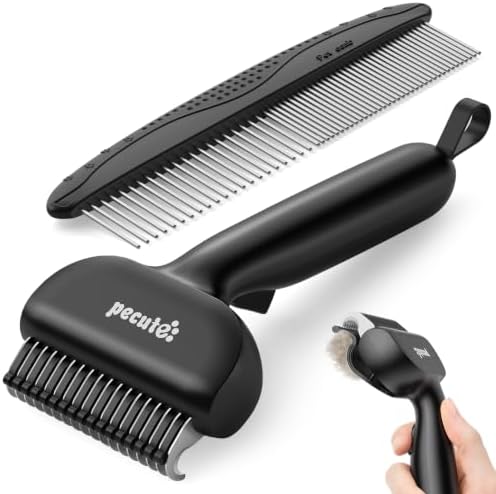
- 1-CLICK SELF-CLEANING — NO MORE MANUAL HAIR PULLING: This undercoat rake solves the grooming frustration. Just press the…
- REMOVES UP TO 95% OF LOOSE FUR — DESIGNED FOR THICK DOUBLE COATS: Engineered specifically for dense undercoats and heavy…
- GENTLE DEMATTING — ROUNDED TEETH GLIDE WITHOUT IRRITATING SKIN: Unlike sharp dematting rakes for dogs, our fine-polished…
Undercoat Rake Breakdown: The Tool That Actually Stops Shedding
An undercoat rake has widely spaced, rigid teeth that are longer than a slicker brush’s bristles. Those teeth are built to sink past the topcoat and comb through the dense undercoat sitting closer to the skin. This is the tool doing the actual work when it comes to reducing shedding volume.
The American Kennel Club’s grooming guidelines note that double-coated breeds can shed up to twice as much during seasonal blowouts, which is exactly when an undercoat rake earns its keep. Running a rake through the coat once or twice a week during these periods pulls out the loose undercoat before it has a chance to felt into a mat or end up all over your couch. You can read more on general shedding and coat care from the American Kennel Club.
Undercoat Rake Pros:
- Reaches the dense undercoat layer a slicker brush can’t touch
- Significantly reduces loose hair shedding around the house
- Helps prevent mats before they start, rather than cutting them out later
- Especially effective during spring and fall seasonal shedding
Undercoat Rake Cons:
- Can feel harsh if used with too much pressure or too often
- Not ideal as the only tool for daily surface maintenance
- Requires a gentler hand around bony areas like hips and the spine
- Less effective on very short or freshly clipped coats
For rake-style deshedding, the Histotree Purple Yellow 2-in-1 Pet Dematting&Deshedding tool combines rake teeth on one side with a dematting blade on the other, which is handy if you’re dealing with both loose undercoat and a few stubborn tangles in the same session.

- 2-in-1 Dematting&Deshedding Dog Brush:Our Histotree purple-yellow dog grooming brush perfectly combines a dematting comb…
- Sharp Stainless Steel Blades:Crafted with premium stainless steel,the detangling comb teeth are precision-cut to glide t…
- Ergonomic Non-Slip Handle:Designed with rubber handle,this dog dematting comb offers a comfortable,secure grip during lo…
Slicker Brush vs Undercoat Rake: Side-by-Side Comparison
Here’s how the two tools stack up when you put them side by side for a Goldendoodle’s specific coat needs. This comparison also factors in a couple of dematting comb options worth having on hand for stubborn spots.

| Tool | Best For | Coat Type Match | Frequency | Price Tier |
|---|---|---|---|---|
| Slicker Brush | Daily surface detangling, finishing touches | Wavy, loosely curled (F1B) | 3-5x per week | $ |
| Undercoat Rake | Deep shedding removal, mat prevention at the root | Dense curl, heavy undercoat (F1, F2B) | 1-2x per week, more during shedding season | $$ |
| Self-Cleaning Deshedding Brush | Combo surface work with easy fur cleanup | Thick double coats | 2-3x per week | $$ |
| 2-in-1 Dematting/Deshedding Tool | Undercoat removal plus tangle cutting | Curl-prone, mat-prone coats | 1-2x per week | $$ |
| Double-Sided Dematting Comb | Spot-treating existing small mats | Any Goldendoodle coat type | As needed | $ |
The Weekly Routine That Actually Keeps Shedding Under Control
Using either tool alone is like only doing half the job. The real fix is layering them together on a schedule that matches your dog’s coat type and the season.
- Start with the undercoat rake. Work in the direction of hair growth, using light, even strokes. This pulls out the loose, dead undercoat before you do anything else.
- Check for hidden mats. Run your fingers behind the ears, under the front legs, and around the collar area. These spots mat fastest because of friction and moisture.
- Use a dematting comb on any tight spots. A tool like the 2 Pack Double Sided Dematting Comb for Dogs Cats is built specifically for cutting through small mats without yanking on the skin underneath.
- Finish with the slicker brush. Smooth the topcoat, work out any remaining surface tangles, and leave the coat looking even and fluffed.
- Reward calmly. Keep sessions short (10 to 15 minutes) and end on a positive note with a treat or praise so your dog doesn’t start dreading brush time.
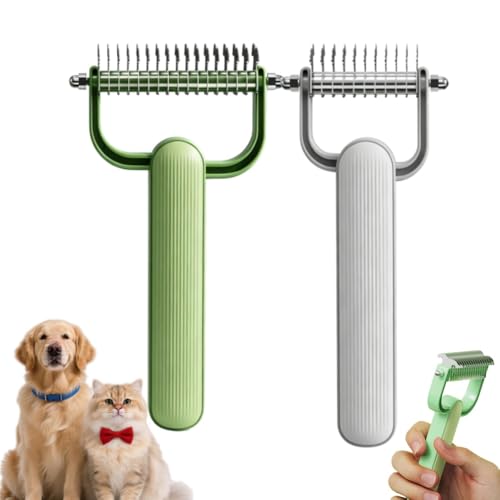
- ✨【Efficient Hair Removal Experience】The V-tooth pet grooming comb features efficient hair removal, designed for both cat…
- 🌀【Upgraded Material】This deshedding comb is crafted from upgraded material, providing durability, suitable for long term…
- 🖐【Ergonomic Handle for Comfort】The ergonomic handle of this pet comb offers comfortable design with a soft, fitted grip,…
Do this once or twice a week outside of shedding season, and bump it up to two or three times a week during spring and fall blowouts. It sounds like a lot at first, but a Goldendoodle who’s used to a consistent routine tends to relax into it fast, especially once brushing stops meaning “this is going to hurt.”
When Brushing Alone Isn’t Enough
If you’re finding mats no brush or rake can safely work through, or if your dog’s coat has matted down to the skin in large sections, it’s time to call a professional groomer rather than force it at home. Attempting to cut out severe mats yourself risks nicking the skin, since mats often sit tighter to the body than they appear.
This is also a good moment to think about your grooming setup as a whole. If your Doodle’s coat regularly gets to the point where a full shave feels necessary, this guide on what to look for in a dog clipper kit walks through the features that matter most for thick, curly coats. And if you’re still deciding between breeds and want a sense of overall grooming demands, this comparison of a Goldendoodle vs Golden Retriever for lower maintenance coats is worth a look before you commit to a specific generation.
Safety-First Takeaway
Both tools matter, but they’re not interchangeable. A slicker brush keeps the surface smooth day to day, while an undercoat rake is doing the heavy lifting that actually reduces shedding volume and stops mats from forming at the root. Skip the rake, and you’ll keep chasing surface tangles while the real problem builds underneath.
Whatever combination you land on, go slow, watch your dog’s body language, and stop if you notice skin redness or sensitivity. A calm, consistent grooming routine protects your Goldendoodle’s skin and coat, and it keeps grooming time something your dog tolerates instead of dreads.
Is an undercoat rake safe for a curly Goldendoodle coat?
Yes, an undercoat rake is safe for curly Goldendoodle coats when used with light pressure and slow, even strokes. It’s actually one of the better tools for curly coats since it can reach the dense undercoat trapped beneath the curls, which is exactly where hidden mats tend to form.
How often should I use a slicker brush versus an undercoat rake?
A slicker brush works well for three to five sessions a week as light daily upkeep, while an undercoat rake is better used once or twice a week, increasing to two or three times during spring and fall shedding season when undercoat buildup is heaviest.
Can I use a slicker brush alone to stop Goldendoodle shedding?
A slicker brush alone usually isn’t enough to stop shedding in Goldendoodles with a moderate to heavy undercoat. It smooths the topcoat and catches surface tangles, but it doesn’t pull out the deep undercoat fur that causes most of the shedding and matting, which is where an undercoat rake becomes necessary.
Which Goldendoodle generation sheds the most and needs a rake the most?
F1 Goldendoodles typically carry the heaviest undercoat and shed the most, making an undercoat rake especially important for that generation. F1B and F2B Goldendoodles shed less visibly, but their curlier coats still trap loose undercoat fur, so a rake remains an important part of their grooming routine as well.


