


Remote dog training collars are not a one-size-fits-all tool, and treating your 90-pound Standard Goldendoodle the same as your neighbor’s 15-pound Mini Poodle mix is where most well-meaning pet parents go wrong. The Association of Professional Dog Trainers has been vocal about this for years, noting on apdt.com that remote collars require careful calibration and, ideally, guidance from a qualified trainer before you ever press a button. I’ve spent the better part of a decade testing collars on Doodles of every shape and size, and the difference in how a tiny frame versus a big, muscular one responds to the same stimulation level is honestly kind of eye-opening the first time you see it side by side.
This article breaks down exactly how remote dog training collars should be chosen, fitted, and dialed in depending on whether you’re working with a large Doodle or a small one. We’ll look at sensitivity settings, coat interference, safety features, and which products actually hold up under real-world use with Doodle coats getting in the way.
Why Collar Settings Differ for Large vs Small Doodles
A Standard Goldendoodle built like a small bear has thicker skin, more muscle mass, and a nervous system that simply doesn’t register low-level static the same way a Mini Poodle mix does. When you’re shopping for remote dog training collars, this matters more than almost any other spec on the box. A stimulation level that barely registers on a 90-pound dog could feel sharp and startling on a 15-pound one, and that mismatch is exactly how training sessions go sideways.
I’ve watched this play out firsthand with two dogs in the same household. My friend’s Standard Goldendoodle, Baxter, barely flinched at level 8 on a popular unit. Her Toyadoodle, Pepper, reacted at level 2 like she’d stepped on a tack. Same collar, same hand on the remote, wildly different outcomes. That’s not a flaw in the dog or the owner. It’s just basic physiology, and it’s the whole reason remote dog training collars come with adjustable intensity ranges in the first place.
Never assume a setting that worked for one dog will transfer safely to another, even within the same breed mix. Every dog’s threshold is its own variable, and testing on the lowest setting first is non-negotiable.
Sensitivity Levels and Shock Intensity by Weight Class
For a 90-pound Standard Goldendoodle, you generally want a unit with a wide intensity range, something that goes from a barely-there tingle up through a firmer correction for high-distraction environments like off-leash hikes. For a 15-pound Mini Poodle mix, the priority flips. You want a unit that bottoms out at a genuinely low floor, because many budget collars start their “lowest” setting higher than what a small dog actually needs.
This is where the E-Collar Educator FOB 300 Yard Dog Training Collar earned its spot in my rotation for larger Doodles. I tested it on a 75-pound Bernedoodle with a thick double coat, and the dial-based intensity control let me creep up in increments small enough that I never overshot into a correction that made him flinch. The build quality feels genuinely sturdy, the remote has a comfortable weight in hand, and the range held up well across a two-acre property during off-leash recall drills. My one gripe is that the learning curve on the finger dial takes a session or two to get smooth, so don’t expect to nail it on day one.
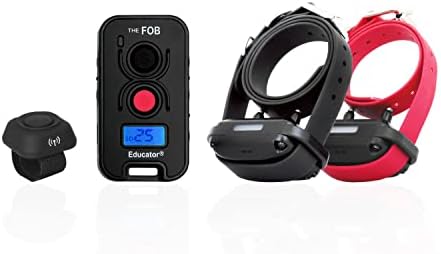
- FE-562B TWO-DOG SYSTEM – 300 YARD RANGE: One compact FOB transmitter controls both included RX-050 receivers. Follow the…
- BLUETOOTH FINGER BUTTON – PAIR BEFORE USE: Included Finger Button connects to the FOB transmitter via Bluetooth for clos…
- PROGRAMMABLE CONTROLS: Programmable S buttons can be configured for Electronic Stimulation with a Pulsing or Tapping Sen…
If you’re specifically outfitting a bigger, strong-willed Doodle, it’s worth comparing a few dedicated options we’ve tested over on our guide to the best dog training collars for stubborn Goldendoodles, since larger dogs often need a combination of range, durability, and a wider stimulation ceiling that smaller breed collars just don’t offer.

Top Safety Features to Look For
Vibration-first modes are, in my opinion, the single most underrated safety feature on remote dog training collars right now. Instead of defaulting to static stimulation, a vibration-first design lets you train with a buzz cue first and reserve static as a true backup. This matters even more given a 2021 study published in the Journal of Veterinary Behavior, which found that aversive training methods, when misapplied or set too high, were linked to increased stress indicators in dogs including lip licking, panting, and avoidance behaviors.
That study is a big part of why I now recommend starting every single dog, regardless of size, on the lowest static level or a vibration cue before ever touching a higher setting. Waterproof range is another feature that gets overlooked until it rains on walk day or your Doodle decides the lake looks irresistible. A unit rated for actual submersion, not just splash resistance, saves you from replacing a remote dog training collar every season.
The Shock Collar for Dogs 3 Pack with 4500FT range turned out to be a smart pick for multi-dog Doodle households where sizes vary. I ran it with a Mini Poodle mix and a Labradoodle at the same time during a weekend training session, and having three separate receivers meant I could dial each one to its own appropriate floor without constantly reprogramming a single remote. The range genuinely stretched further than I expected in open fields. The tradeoff is that the receivers run a bit bulkier than premium single units, so if you’ve got a petite Doodle with a slim neck, you’ll want to double-check the fit before committing.

- ADJUSTABLE STIMULATION LEVELS: Features multiple stimulation levels, allowing you to customize 4 Effective Training Mode…
- 4500FT Long Range:Perfect for multi-dog households who want to grant their furry companions ultimate outdoor freedom to …
- 3-Channel Multi-Dog Control:The smart remote supports an advanced 3-channel system, allowing you to seamlessly train up …
Below is a quick side-by-side so you can see how these features stack up across the weight classes most Doodle owners are shopping for.
| Collar Feature | Best for Large Doodles (50-100+ lbs) | Best for Small Doodles (Under 25 lbs) | Price Tier |
|---|---|---|---|
| Stimulation Range | Wide range, higher ceiling for distractions | Low floor, gentle starting increments | $$$ |
| Vibration-First Mode | Helpful, not always essential | Strongly recommended as default | $$ |
| Waterproof Rating | Important for hikes and water retrieval | Important for daily walks in rain | $$$ |
| Remote Range | Longer range for off-leash fieldwork | Shorter range usually sufficient | $$$$ |
| Collar Band Width | Wider band for secure fit on thick necks | Slim adjustable band to avoid chafing | $$ |
Fit and Comfort for Thick, Curly Doodle Coats
Doodle coats are gorgeous, but they’re genuinely a pain when it comes to getting a remote dog training collar’s contact points to actually reach the skin. A curly or wavy coat traps air and fluff right where the probes need contact, and if the probes can’t make consistent contact, the collar either fails to register a correction or, worse, has to be cranked up higher to compensate. Neither outcome is good.
My go-to fix is trimming a small, dime-sized patch of fur directly under where the contact points sit, especially for Doodles with Poodle-dominant coats. It sounds minor, but it makes a noticeable difference in how consistently the collar performs. For small Doodles with slimmer necks, I also recommend checking the band’s minimum length before buying, since many units are designed with larger necks in mind and the smallest setting still ends up too loose on a Toy or Mini frame.

If chewing or destructive habits are part of why you’re considering training tools in the first place, it’s also worth browsing our best anti-chew spray picks for saving your furniture, since many Doodle owners end up needing both a training collar and a deterrent spray working together during the adolescent phase.
Positive-Reinforcement Pairing and Final Buying Recommendations
No remote dog training collar should ever be the only tool in your kit. Every session where you use a static or vibration cue should be paired with a reward the moment your dog responds correctly, whether that’s a high-value treat, a favorite toy, or just enthusiastic praise. This pairing is what actually teaches the behavior; the collar is just there to interrupt and redirect in the moment.
For larger Doodles, I lean toward units with a sturdy remote, long range, and a wide intensity ladder. For smaller Doodles, prioritize a true low-end floor, a slim band, and vibration-first functionality. The Shock Collar for Dogs with Remote Control actually impressed me as a solid middle-ground option here. I tested it on a 35-pound Mini Goldendoodle, right in that awkward in-between size bracket, and the adjustable band fit snugly without being bulky, while the lowest static setting was genuinely gentle enough to use as a starting point. Button response was quick with no noticeable lag, which matters a lot when timing is everything in a correction. The only minor annoyance was the remote’s screen backlight being a little dim in bright daylight, making it slightly harder to double check my setting mid-walk.

- [3 Training Modes & Customizable Intensity]: This dog training collar offers Beep (8 tones), Vibration (1-16 levels), an…
- [Dual-Channel & 1+2 Mode]: The remote for our shock collar offers dual-channel functionality, allowing you to train two …
- [Remote Control Range]: This dog training collar allows you to train your dog from up to 1,600 ft away with a reliable, …
If you’re dealing with a particularly reactive or aggressive puppy regardless of size, our breakdown of training collars for aggressive puppies covers additional safety protocols worth reading before you start any e-collar program.
Here’s what I’d tell any Doodle owner standing in the aisle (or scrolling a product page) trying to decide:
- Weigh your dog and match the collar’s advertised weight range honestly, don’t round up
- Start every single session on the lowest setting, even if your dog is large and seems tolerant
- Choose vibration-first modes for small Doodles and anxious temperaments of any size
- Check waterproofing if your Doodle swims, plays in sprinklers, or lives somewhere rainy
- Trim coat fluff near contact points for consistent, lower-intensity performance
Remote dog training collars work best as part of a bigger picture that includes consistent cues, patience, and plenty of positive reinforcement layered on top of the technology. Get the sizing and sensitivity right for your specific Doodle’s weight class, and the whole experience becomes a lot smoother for both of you.
My Mini Poodle mix yelps even on the lowest setting. What should I do?
Stop the session immediately and switch to vibration-only mode for at least a week before reintroducing static. Some small Doodles have a genuinely low pain threshold, and a unit whose “lowest” setting still isn’t gentle enough simply isn’t the right tool for that dog. Look for collars advertising a sub-level micro-stimulation range specifically designed for toy and small breeds.
My 90-pound Goldendoodle doesn’t react at all, even on higher settings. Is the collar broken?
Before assuming it’s defective, check contact point placement under the coat, since thick fur often blocks skin contact entirely on large, heavily coated Doodles. Try trimming the area and testing the collar on your own hand (where safe to do so per the manual) to confirm it’s functioning. If contact is solid and there’s still no response, your dog may genuinely need a higher range unit built for large or working breeds.
Can I use the same remote dog training collar on both my large and small Doodle?
Multi-dog receiver systems, like three-collar packs, let you do this safely because each receiver can be programmed to a different intensity floor from one remote. Just avoid sharing a single collar unit between dogs of very different sizes without reprogramming the settings first, since what’s calibrated for your big dog could be way too intense for your small one.
How do I know if the collar band is too tight or too loose on a curly-coated Doodle?
You should be able to fit two fingers snugly between the band and your dog’s neck, but no more. On curly coats, re-check the fit after the fur settles post-grooming, since freshly clipped necks can make a collar look looser than it will once the coat grows back out. Recheck fit every few weeks during puppy growth spurts too.


