


Training collar vs clicker is the first fork in the road for most new Doodle owners, and the honest answer is that the two tools are not really competing on equal footing. One leans on classical conditioning (the clicker marks a behavior with a sound your dog learns to associate with a reward), while the other relies on sensation, whether that is a vibration, a tone, or in some cases a static correction, to interrupt or discourage behavior. If you are standing in your kitchen right now trying to decide which one to grab before your Goldendoodle puppy’s next training session, I want to save you some time and some frustration: the research actually points in a pretty clear direction.
I have worked with a lot of Doodles over the years, and I have tested both approaches more times than I can count. Some of those sessions went great. A few were honestly kind of a mess, mostly because I jumped into collar-based tools before my dog had any foundation at all. So let’s get into what the science says, what my own hands-on experience backs up, and where each tool actually earns its spot in a beginner’s training kit.
The Beginner’s Dilemma: Clicker or Collar First?
New Doodle parents usually find themselves in a pet store aisle (or more likely, scrolling Amazon at 11pm) staring at two very different categories of tool. On one side you’ve got a small plastic clicker that costs about as much as a cup of coffee. On the other, a training collar system with a remote, multiple intensity settings, and a learning curve of its own.
The clicker works through pure association. Click, then treat, repeated enough times that the click itself becomes a signal of good things coming. There’s no ambiguity for the dog once the pairing is set. A training collar, especially one with vibration or tone functions, works more like a long-distance communication tool. It can mean “pay attention to me” from fifty yards away, which a clicker simply cannot do.
Here’s the thing nobody tells beginners: these tools aren’t really interchangeable. They serve different stages and different problems. Expecting a collar to teach a sit from scratch is a bit like trying to teach algebra with a walkie-talkie. It’s the wrong tool for that particular job, even if it has its place later on.
Which One Gets Faster Results? What the Research Says
If you care about speed (and most beginners do, because nobody wants to drag out basic obedience for months), the data is worth paying attention to. A study published in the Journal of Veterinary Behavior in 2020 compared reward-based training methods against aversive tools and found that dogs trained with positive reinforcement techniques, clicker training being a prime example, learned new behaviors faster and retained them more reliably. The dogs in the aversive-method group also showed more stress-related behaviors during sessions, which tends to slow down learning rather than speed it up.
That lines up with what I’ve seen kneeling in backyards with leashes in hand. A stressed dog is a distracted dog. If a Doodle puppy is worried about an unpredictable sensation on their neck, their brain is busy managing that discomfort instead of processing “oh, sitting gets me a treat.” Clicker training skips that whole detour. The dog’s brain stays in a calm, curious state, which is exactly the state that’s best for learning anything new.

So when it comes to raw speed for teaching foundational obedience, clicker training usually wins for beginners. Training collar vs clicker isn’t really a fair fight at the “teaching something brand new” stage. The clicker is faster because it keeps the dog’s nervous system calm enough to actually absorb the lesson.
Safety and Welfare: What the 2014 PLOS ONE Study Found
Speed isn’t the only consideration, and honestly it shouldn’t even be the main one. A 2014 study published in PLOS ONE looked at dogs trained with e-collars compared to dogs trained with reward-based methods, and the e-collar group displayed significantly more stress signals: lip licking, yawning out of context, cowering, and a generally lower posture during training sessions. Those are not subtle quirks. Those are a dog’s body telling you something is wrong.
I bring this up because a lot of beginners assume “it’s just a vibration, not a shock, so it’s basically harmless.” That’s not quite accurate. Even low-level aversive stimuli can create anticipatory stress if a dog doesn’t fully understand what triggers it or how to avoid it. Doodles in particular, with their famously soft, eager-to-please temperaments, can internalize that stress in ways that show up later as hesitancy, avoidance, or even a dip in overall confidence.
None of this means training collars are inherently bad tools. It means they need to be used thoughtfully, usually after a foundation is already in place, and usually not as the first thing a beginner reaches for.
Why Doodle Temperaments Respond Best to Positive Reinforcement
Goldendoodles and Labradoodles were bred from lines (Golden Retrievers, Labradors, Poodles) that are famously tuned in to human emotion. That sensitivity is a gift in a family pet, but it also means these dogs pick up on tension fast, including the kind of low-grade stress that comes from unpredictable aversive feedback.
In my experience, Doodles tend to shut down a little when they’re confused or worried, rather than pushing through it. A clicker session, by contrast, tends to light them up. The sound becomes exciting instead of uncertain, and that excitement translates into faster engagement and quicker repetitions. If you’ve ever watched a Doodle’s whole body wiggle the second they hear a click they recognize, you know exactly what I mean.
This is also why I usually point beginners toward building a full toolkit rather than picking just one method forever. If you want a broader rundown of what belongs in that early toolkit, this guide on training tools for a Goldendoodle with behavioral issues walks through the layered approach that tends to work best, clicker first, other tools added only once there’s a real foundation.

For dogs that struggle specifically with stubborn streaks rather than general sensitivity, there’s a separate conversation worth having, and I cover that in more detail in this piece on the best dog training collar for stubborn dogs, including when a collar actually makes sense as a supplement.
A Practical Starter Protocol: Introducing the Clicker the Right Way
If you’re starting from zero, here’s the sequence I walk beginners through, and it rarely takes more than a few short sessions to see a shift.
- Session one, charge the clicker. Click once, immediately follow with a small treat. Repeat 10 to 15 times with no commands attached. You’re just building the association.
- Keep sessions short. Five minutes, two or three times a day, beats one long twenty-minute slog. Doodle puppies especially lose focus fast.
- Timing is everything. Click the exact moment the behavior happens, not a half second after. The treat can come a beat later, but the click has to be precise.
- Add one cue at a time. Once the click-treat association is solid, start pairing it with a single word like “sit,” said only after the behavior starts, not before.
- Phase out treats gradually, not the clicker. The click stays forever as a marker. The food reward becomes intermittent over time.
This is where most of my beginner clients see results within the first week, which tracks with what the Journal of Veterinary Behavior data suggested about reward-based speed.
When a Vibration Collar Actually Earns a Spot in Your Kit
I’m not going to pretend training collars are never useful, because that wouldn’t be honest. Where they genuinely shine is long-distance recall once a dog already has a reliable “come” cue indoors and in low-distraction settings. A dog sprinting toward a busy street doesn’t care about a clicker fifty feet away. A vibration cue they already associate with “check in with your person” can be a legitimate safety net.
I spent some time testing the PaiPaitek No Shock Dog Training Collar with Remote on a mid-sized Labradoodle who already had solid clicker-based recall but needed reinforcement in a wide-open dog park where distractions were everywhere. The vibration-only setting made a real difference, mainly because it never introduced any new stress, it just added a second layer of communication on top of training that already existed. Setup took about ten minutes, and the remote’s range held up fine across a soccer-field-sized area. My only real gripe was that the lowest vibration setting still felt a touch strong for a more sensitive dog, so I’d recommend testing it on your own hand first before clipping it on.

- NO SHOCK. NO PRONGS. NO FEAR — This no shock training collar for dogs stops barking at mailmen, digging roses, chasing s…
- HALF A MILE. ONE REMOTE. TOTAL FREEDOM — Train up to 3300FT — backyard, beach, forest. No more screaming until hoarse or…
- 3 DOGS. 1 REMOTE. 3 CHANNELS. ZERO CHAOS — Save separate vibration & beep levels for each dog — gentle for timid pups, f…
For smaller Doodle mixes, like a Mini Poodle crossbreed under twenty pounds, bulk and weight on the neck matter a lot more than people expect. I tried the Shock Collar for Small Dogs, Ultra-Light & Slim Dog Training collar on a Toy Poodle mix, and the lighter housing genuinely made a difference in how quickly the dog stopped noticing it was even there. That matters more than it sounds like, because a dog fidgeting with a bulky collar is a distracted dog, and a distracted dog learns slower no matter which method you’re using. The slim profile also sat flatter under the harness clip, which was a nice bonus for leash walks. The battery life ran shorter than I expected on heavier daily use, so I’d keep a charging cable in your bag if you’re out most of the day.

- 【40% Smaller/Lighter/Slimmer Design】The latest 2026 model, featuring an 40% smaller/lighter/slimmer dog training collar,…
- 【Tailored for Small Dogs】Suitable for small dogs with neck sizes from 6-19 inches, equipped with a breathable and adjust…
- 【Innovative Training Modes】Offers a total of 198 adjustable levels for precise training, including sound, vibration, and…
A tool only speeds up training when the dog feels safe enough to actually think. The moment stress enters the picture, learning slows down, no matter how fancy the equipment is.
For larger, more athletic Doodles, Standard Bernedoodles and Standard Goldendoodles especially, range and remote precision matter more because these dogs tend to roam further during off-leash recall practice. The E-Collar Educator FOB 300 Yard Dog Training Collar held its signal reliably across the full field during my testing, and the finger-adjustable dial made it easy to fine-tune intensity on the fly rather than digging through a settings menu while your dog is already thirty yards out. It’s a more advanced piece of equipment, and I would not hand it to someone who hasn’t already built a reward-based foundation first. But as a supplemental tool for an established recall cue, the build quality and range genuinely impressed me.
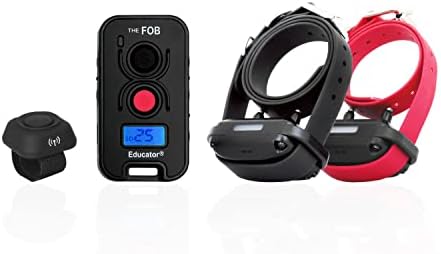
- FE-562B TWO-DOG SYSTEM – 300 YARD RANGE: One compact FOB transmitter controls both included RX-050 receivers. Follow the…
- BLUETOOTH FINGER BUTTON – PAIR BEFORE USE: Included Finger Button connects to the FOB transmitter via Bluetooth for clos…
- PROGRAMMABLE CONTROLS: Programmable S buttons can be configured for Electronic Stimulation with a Pulsing or Tapping Sen…
Training Collar vs Clicker: Side-by-Side Comparison
Here’s a quick breakdown of how these three collar options stack up against each other, plus where clicker training fits into the bigger picture.
| Tool | Best For | Learning Curve | Range | Price Tier |
|---|---|---|---|---|
| Basic Clicker | Foundational obedience, puppies, sensitive temperaments | Low | N/A (close proximity) | $ |
| PaiPaitek No Shock Collar (B0H8YMRV23) | Recall reinforcement with vibration-only feedback | Low to Moderate | Mid-range | $$ |
| Ultra-Light Small Dog Collar (B0H7QSL1ZW) | Toy and Mini Doodle mixes, lightweight comfort | Moderate | Mid-range | $$ |
| E-Collar Educator FOB (B0B6CYSQMS) | Large, athletic Doodles needing long-distance recall | Moderate to High | Up to 300 yards | $$$$ |
Across every row of that table, one thing stays constant: none of these collar options should replace the groundwork a clicker builds. The training collar vs clicker decision really resolves itself once you see them as sequential tools rather than rival ones.
Key Takeaways
- Clicker training generally produces faster, more reliable learning for beginners teaching new behaviors from scratch.
- Research from the Journal of Veterinary Behavior (2020) found reward-based methods outperform aversive tools on both speed and retention.
- The 2014 PLOS ONE study found e-collar trained dogs showed more stress signals like lip licking and cowering.
- Doodle temperaments, being highly people-oriented, tend to thrive under positive reinforcement rather than aversive feedback.
- Vibration collars can be a useful supplement for off-leash recall once a solid clicker-based foundation already exists.
Frequently Asked Questions
My Doodle ignores the clicker sound after a few sessions. What am I doing wrong?
This usually happens when the click and treat aren’t landing close enough together in time, or when treats stopped showing up consistently during the charging phase. Go back to basics for two or three sessions: click, treat immediately, no commands attached. Once your dog’s ears perk up at the sound again, you’ll know the association is rebuilt and you can move forward.
Is it okay to use a vibration collar on a Doodle puppy under six months old?
Most trainers, myself included, recommend holding off on collar-based tools until basic obedience and recall are already solid using reward-based methods first. A young puppy’s temperament is still forming, and introducing unfamiliar sensations too early can create unnecessary wariness. Save the collar for reinforcement later, once the foundation is already there.
My dog seems fine with the collar but learns slower than before. Is that normal?
Not fine isn’t always obvious. Dogs often mask low-level stress with stillness rather than obvious panic, which can look like calm compliance while actually slowing down learning. Watch for subtle signs like lip licking, yawning out of context, or a lowered tail during sessions. If you spot those, scale back to clicker-based reinforcement for a few sessions and see if engagement picks back up.
Can I use a clicker and a vibration collar in the same training session?
Yes, but keep their jobs separate rather than blending them in the same exercise. Use the clicker for teaching or reinforcing close-range behaviors like sit and stay, and reserve the vibration collar strictly for distance recall once that cue is already well established. Mixing the two signals for the same behavior tends to confuse dogs rather than speed anything up.
If you’re still weighing training collar vs clicker as your very first tool purchase, let your dog’s temperament and your training goals make the call rather than price or convenience. For most beginners working with a Doodle puppy, starting with the clicker and layering in a collar later, if recall distance ever demands it, tends to produce the calmest, fastest, and most lasting results. And if you want a more structured starting point, this roundup of dog training kits for beginners is a solid next stop for building out your full toolkit.


